
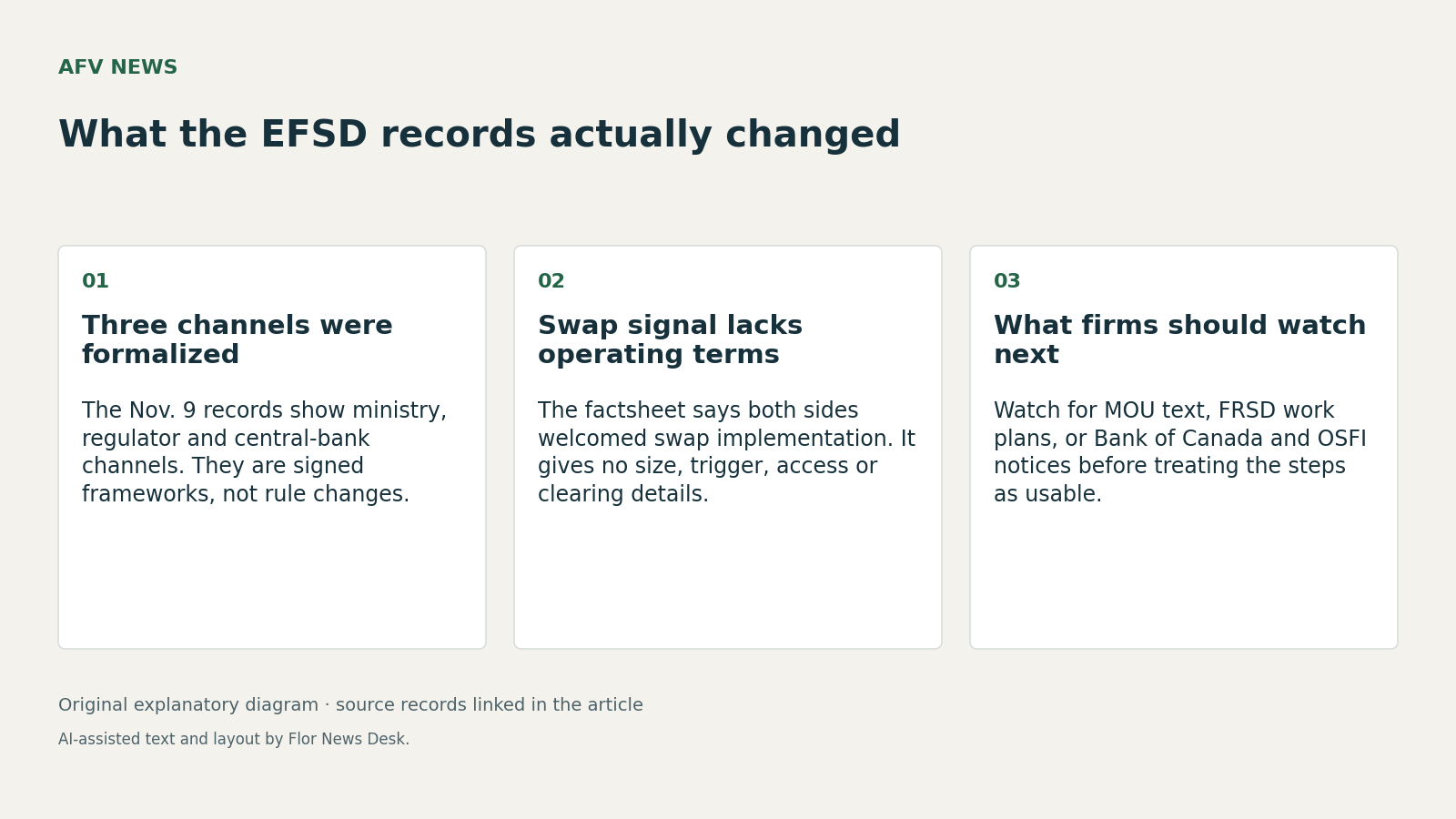
Canada and China left the November 8–9, 2026 Economic and Financial Strategic Dialogue in Vancouver with more than a generic pledge to keep talking. Finance Canada’s November 9 joint factsheet says the two finance ministries signed a Memorandum of Understanding on Cooperation, the countries’ financial regulatory authorities signed a Cooperation Agreement for the Financial Regulatory and Supervisory Dialogue, the central banks signed Terms of Reference for the Financial Working Group, and both sides welcomed implementation of a bilateral currency swap arrangement. Those are verifiable institutional steps, not merely future intentions. Joint factsheet Finance Canada release
The November documents matter because they convert earlier political intent into named channels with identified institutions. A joint statement published on April 4, 2026 had already said the Canada-China Financial Working Group was launched after the January 2026 Canada-China Economic and Trade Cooperation Roadmap and held an inaugural meeting in Beijing on April 3. The November factsheet adds that the central banks have now signed terms of reference for that group. What the April record does not establish, however, is whether its expectation of another meeting in the second half of 2026 was met; that timeline is now in the past and stale. April working group statement Joint factsheet
For Canadian firms, the practical distinction is between a framework and an operating privilege. The finance-ministry MOU is a government-to-government cooperation instrument. The FRSD agreement sits at the regulator level: Finance Canada says OSFI and China’s National Financial Regulatory Administration signed it, and that an inaugural FRSD meeting was held to support future technical cooperation on regulation and supervision. None of the public records publish the text of the MOU, the FRSD work plan, any market-access commitments, or any rule change that a bank, insurer, exporter or investor could rely on as an immediate entitlement. Finance Canada release Joint factsheet
The currency-swap reference is the most consequential signal, but also the least detailed for commercial use. The November 9 factsheet says both sides welcomed implementation of a bilateral currency swap arrangement. That wording is stronger than a bare proposal, because it indicates the governments are describing something as implemented. Still, the record released publicly does not say the arrangement’s size, term, activation triggers, eligible users, settlement path, clearing-bank setup or whether any liquidity has been drawn. On the present record, businesses can treat the swap as a policy development, not as proof of accessible renminbi or Canadian-dollar funding. Joint factsheet
Trade volumes explain why businesses will watch the finance architecture closely. Finance Canada’s release says Canada-China two-way merchandise trade reached $125.7 billion in 2025 and says Canadian merchandise exports to China were up 41 per cent year to date in 2026 versus the same period of 2025. But the department does not state the cutoff date for that year-to-date comparison, so the figure cannot be used to show any effect from the November 8–9 dialogue itself. It is context for the scale of the commercial relationship, not evidence of a measured policy outcome from these new instruments. Finance Canada release
The difference between dialogue and implementation also shows up in the energy file. Natural Resources Canada’s November 4 joint readout says the two governments encouraged energy enterprises to explore trade, technology exchange, investment and project cooperation across conventional and renewable energy, civil nuclear energy and uranium resources. That matters for the AFV News audience because financing, supervision and payment channels can shape whether sectoral opportunities are practical. But neither the energy readout nor the finance documents identify projects, approvals, contracts, funding receipts or participating companies that would let readers trace a direct commercial result yet. NRCan energy readout Joint factsheet
The near-term reporting test is straightforward. Businesses should look for the missing operational records: publication of the MOU text or an implementation schedule, OSFI or Bank of Canada material explaining the FRSD or Financial Working Group terms, and any official notice that defines how the swap can be activated or accessed. Until those appear, the November 9 package is best read as a formal opening of channels between ministries, regulators and central banks, with commercial implications still to be proven. The factsheet’s statement that the next EFSD is expected in China is only an expectation, not a dated commitment. Joint factsheet April working group statement
Read our editorial standards or send a correction to the editorial desk.