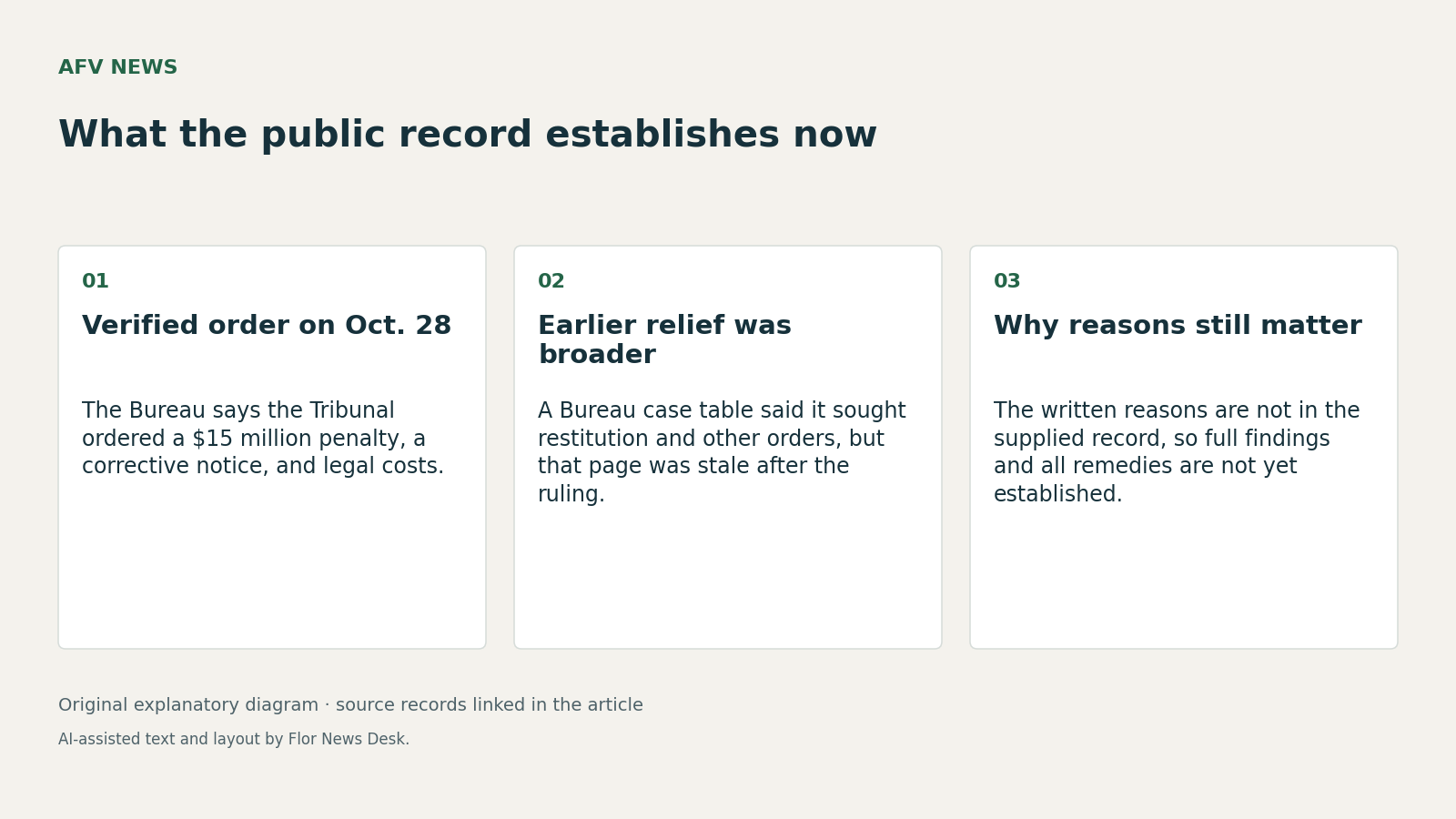
Rogers now faces a verified enforcement cost in the Competition Bureau’s deceptive-marketing case over its ‘Infinite’ wireless plans: the Bureau says the Competition Tribunal ordered a $15 million penalty, a corrective notice and payment of the Bureau’s legal costs on 2026-10-28. The Bureau’s news-release index separately lists that statement on the same date, which helps confirm the timing of the public announcement even though it adds no new case detail. Bureau statement news releases index
For business readers, that matters immediately because the remedy is not only financial. A corrective notice requires a public change in messaging, and a costs award adds another direct consequence beyond the headline penalty. Those two elements suggest the case is relevant to internal approval processes for advertising claims, not just to litigation reserves. That inference rests on the remedies the Bureau says were ordered, not on any yet-public Tribunal reasoning. Bureau statement
The limit of the current record is just as important as the outcome. As of 2026-10-30, the supplied sources do not include the Tribunal’s written reasons or the order text itself. The Bureau says full reasons are expected within 10 business days of the ruling. Until those reasons are public, the record here cannot establish the Tribunal’s detailed factual findings, the legal basis for the decision, or whether any remedy went beyond the penalty, corrective notice and costs described in the Bureau’s statement. Bureau statement
That uncertainty is material because the Bureau’s older case table shows a broader set of remedies had been sought. In a row dated 2024-12-23, the Bureau’s deceptive-marketing cases page says it filed an application alleging false advertising of Infinite wireless phone plans as unlimited data and was seeking, among other things, an order to stop the advertising, a penalty and restitution to customers. But that same page has a 2026-07-28 modified date and still showed the Rogers matter as ongoing, so it is stale for current-status purposes after the 2026-10-28 ruling. cases and outcomes
The practical implication is narrower than some initial reactions may assume. The public record supports saying the Bureau won a significant deceptive-marketing case and secured money, corrective messaging and costs. It does not yet support saying customers will receive restitution, that Rogers was ordered to stop specific advertising, or that the Tribunal adopted a sweeping rule for all telecom “unlimited” offers. Those questions may be answered later, but they are not answered by the records supplied here. Bureau statement cases and outcomes
The Bureau’s statement also gives the case a long runway: it says the application was filed on 2024-12-23 and the hearing ran from 2026-03-30 to 2026-05-01. For compliance teams, that timeline points to a second business lesson. Even before the written reasons arrive, a contested advertising case can carry multiyear cost exposure and end with a public correction order, not merely a private settlement or a withdrawn campaign. Bureau statement
So the clearest conclusion on 2026-10-30 is not that every substantive issue is settled. It is that the enforcement risk is now measurable, while the precedent is only partly visible. Canadian telecom and subscription marketers have a concrete penalty to study now. Investors, competitors and consumers still need the Tribunal’s written reasons before drawing firmer conclusions about what exactly was proved and what remedies, if any, extend beyond the three the Bureau has already listed. Bureau statement
Read our editorial standards or send a correction to the editorial desk.