

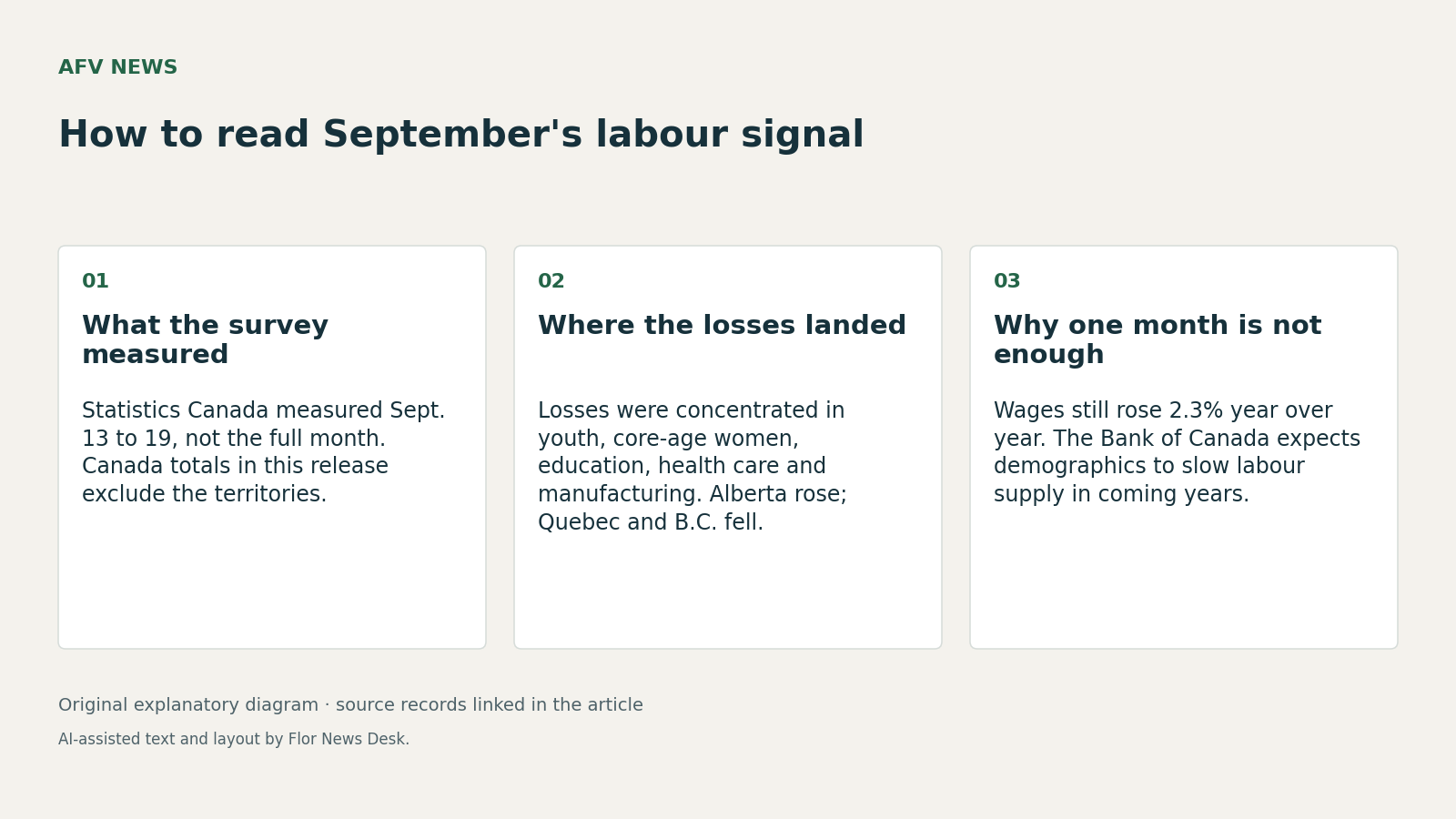
Canada’s September labour survey gives employers a clearer near-term signal than a broad national average does: hiring conditions softened, but not evenly. Statistics Canada reported on October 9 that employment was 21,105,000 in September 2026, down 68,000 from August, while the employment rate fell 0.2 percentage points to 60.6% and the unemployment rate rose to 6.5%. The agency’s Labour Force Survey reflects the reference week of September 13 to September 19, not the full month, and its Canada totals exclude the territories. Statistics Canada release
The composition of the decline matters more for business planning than the headline alone. Statistics Canada says the largest losses were among youth aged 15 to 24, down 48,000, and women aged 25 to 54, down 28,000. Sector losses were concentrated in educational services, health care and social assistance, and manufacturing, while “other services” increased. Statistics Canada release That mix does not support a simple story that only factories weakened or only services weakened. It points instead to a labour market where staffing pressure changed differently across large employers, making blanket national hiring assumptions less useful.
The provincial breakdown pushes the same point. Statistics Canada reported employment declines in Quebec, British Columbia and Manitoba, while Alberta, Newfoundland and Labrador, and Prince Edward Island posted gains. Statistics Canada release For businesses recruiting across provinces, that means a single Canada-wide hiring budget can hide very different local conditions. A company expanding in Alberta and retrenching in Quebec could face two distinct labour markets at once, even though both decisions sit inside the same national survey month.
Wage data add another caution. Average hourly wages among employees were $37.64 in September 2026, up 2.3% from a year earlier, or $0.86, after 2.0% growth in August, according to Statistics Canada. The agency identifies those wage figures as not seasonally adjusted. Statistics Canada release For employers, that is evidence that pay levels were still drifting higher year over year even as employment fell. It is not evidence of a sudden wage spiral, but neither is it a sign that payroll pressure has disappeared.
The Bank of Canada’s October 8 demographic explainer is useful here because it sketches the medium-term constraint that one monthly survey cannot settle. The Bank says Canada’s population growth slowed to 0.5% in 2025, citing aging and fewer immigrants after policy adjustments. It also says stronger immigration in the early 2020s increased the number of workers and helped ease labour shortages, while fewer immigrants in coming years are expected to mean fewer workers and slower growth. Bank of Canada explainer Those are institutional expectations, not a measurement of September 2026 hiring conditions, but they matter because they argue against treating one soft labour report as proof of lasting labour abundance.
The practical reading for Canadian businesses is narrower than either extreme. September’s survey supports more caution on near-term hiring, especially in markets tied to youth recruitment or sectors that posted losses. But the same source record also shows continuing wage growth, uneven provincial conditions and a central bank expectation that demographic change will restrain labour supply over time. Because Statistics Canada notes that monthly Labour Force Survey estimates can show sampling variability and that its analysis focuses on differences significant at the 68% confidence level, the September report is best used as a budgeting signal, not a stand-alone verdict on the labour market. Statistics Canada release
Read our editorial standards or send a correction to the editorial desk.