

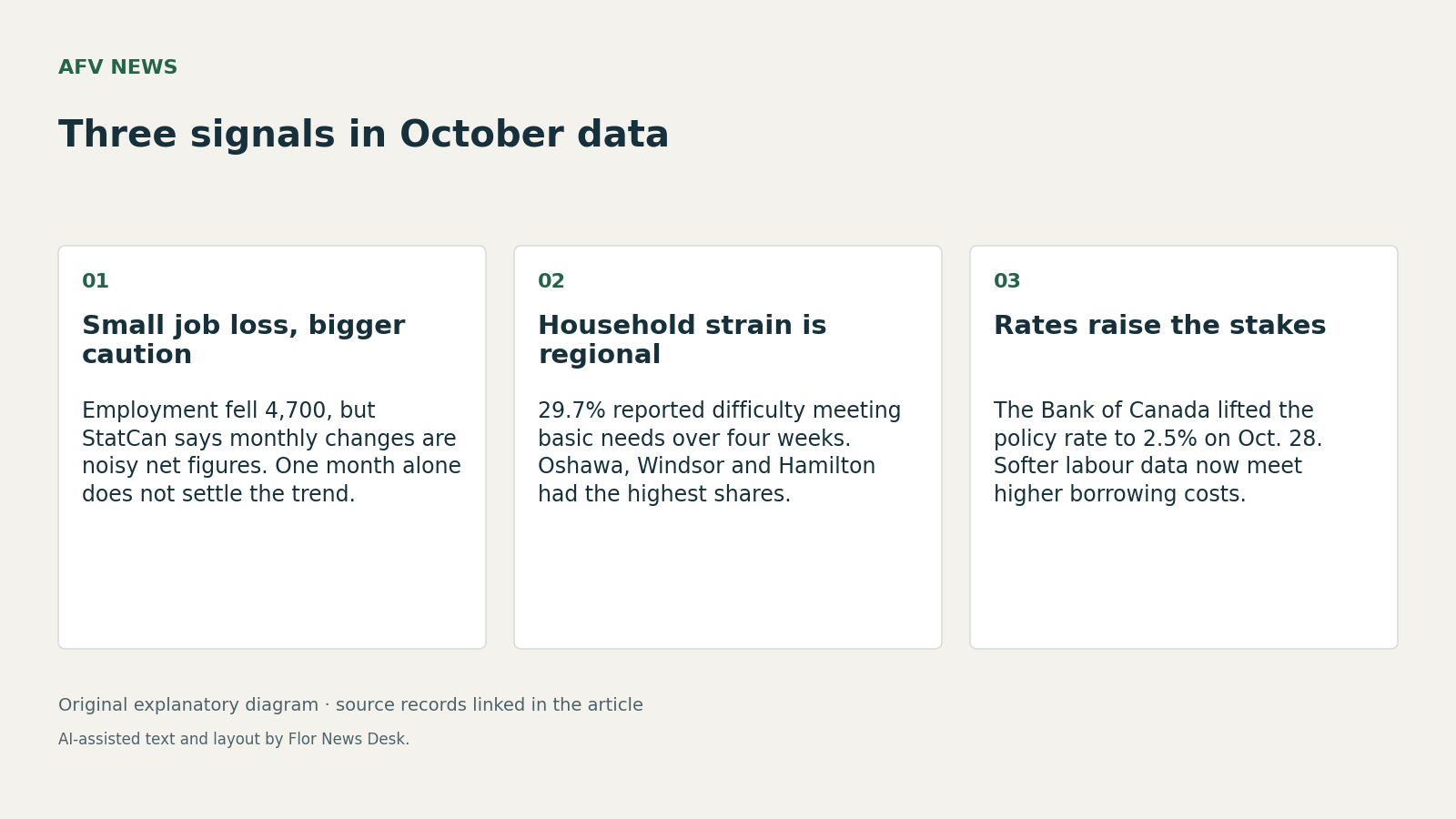
Canada’s October labour data changed the planning signal more on household strain than on the headline job count. Statistics Canada said employment was little changed in October 2026, down 4,700 from September, while the unemployment rate rose 0.2 percentage points to 6.7%. In the same release, StatCan said 29.7% of people aged 15 and older lived in a household that had found it difficult to meet basic financial needs over the previous four weeks. The survey reflects labour market conditions during Oct. 11 to 17 and was published on Nov. 6. Statistics Canada labour release
That small employment decline does not, by itself, establish a sharp turn lower. Statistics Canada’s archived methodological note says the monthly employment figure is a net change rather than a count of all jobs created and lost, and that combining months or using trend estimates improves interpretation because one-month moves are more volatile. The October release’s source record also notes that monthly differences are assessed at the 68% confidence level. For businesses, the stronger message is not the 4,700 decline itself but the broader easing in labour conditions: the employment rate slipped to 60.5% and unemployment reached 1.5 million people. Statistics Canada labour release Statistics Canada methodology note
The sector mix also argues against a single national story. StatCan reported employment fell by 29,000 in wholesale and retail trade, while construction added 16,000 jobs and educational services added 15,000. That does not prove that demand weakened across the whole economy in October. It does mean consumer-facing businesses and their suppliers have more reason than some other sectors to retest near-term sales volumes and staffing assumptions, while firms tied to construction or education cannot assume the same degree of softness from this report alone. Statistics Canada labour release
The more consequential business signal is the household-needs measure. StatCan said 29.7% of Canadians aged 15 and older were living in households that had difficulty meeting basic financial needs over the prior four weeks, with the highest shares among the 15 largest CMAs in Oshawa at 38.4%, Windsor at 36.9% and Hamilton at 35.9%. Because that measure covers a recent four-week period rather than a formal budget or delinquency record, it is better read as a pressure gauge than as proof of missed payments. Still, for retailers, lenders and service providers with exposure in those markets, it gives a concrete reason to recheck collections assumptions, promotional plans and regional demand expectations. Statistics Canada labour release
The timing matters because the Bank of Canada had already tightened again before the labour report was published. On Oct. 28, the Bank raised its target for the overnight rate by 25 basis points to 2.5%, said the unemployment rate had been around 6.5% for several months, and said further increases could be needed because inflation was higher and more persistent than in its July outlook. That means October’s labour survey arrived in a setting where labour slack was becoming more visible even as borrowing costs were still moving higher. For businesses dependent on discretionary spending or variable-rate financing, that is a harder combination than either signal alone. Bank of Canada rate decision Statistics Canada labour release
Labour costs, meanwhile, are not disappearing. StatCan reported average hourly wages for employees rose 2.2% from a year earlier to $37.89 on an unadjusted basis. That suggests a 6.7% unemployment rate does not automatically create easy hiring conditions or immediate margin relief. The source record cannot establish whether October became a durable turning point, and the Canada-level estimates exclude the territories. But taken together, higher unemployment, concentrated household financial strain in named CMAs and a fresh Bank of Canada rate increase are enough to justify a near-term retest of sales, credit and hiring assumptions. Statistics Canada labour release Bank of Canada rate decision Statistics Canada methodology note
Read our editorial standards or send a correction to the editorial desk.