Higher prices after a weather disaster do not necessarily mean a business is selling more or earning more. A September Bank of Canada staff analytical paper examines the broader economic problem behind that distinction: physical damage can reduce productive capacity while putting upward pressure on prices.
Tatjana Dahlhaus's paper on physical climate risks reviews evidence and uses a structural macroeconomic model to examine more frequent and severe disasters. Its scope includes damage to production, housing and infrastructure, alongside supply-chain disruption. The paper describes the resulting challenge for output and inflation, particularly in small open economies.
That is macroeconomic research. It does not provide a forecast for a named business, a local flood warning, an insurance quotation or a prediction of the Bank's next interest-rate decision.
A higher selling price can accompany a smaller total
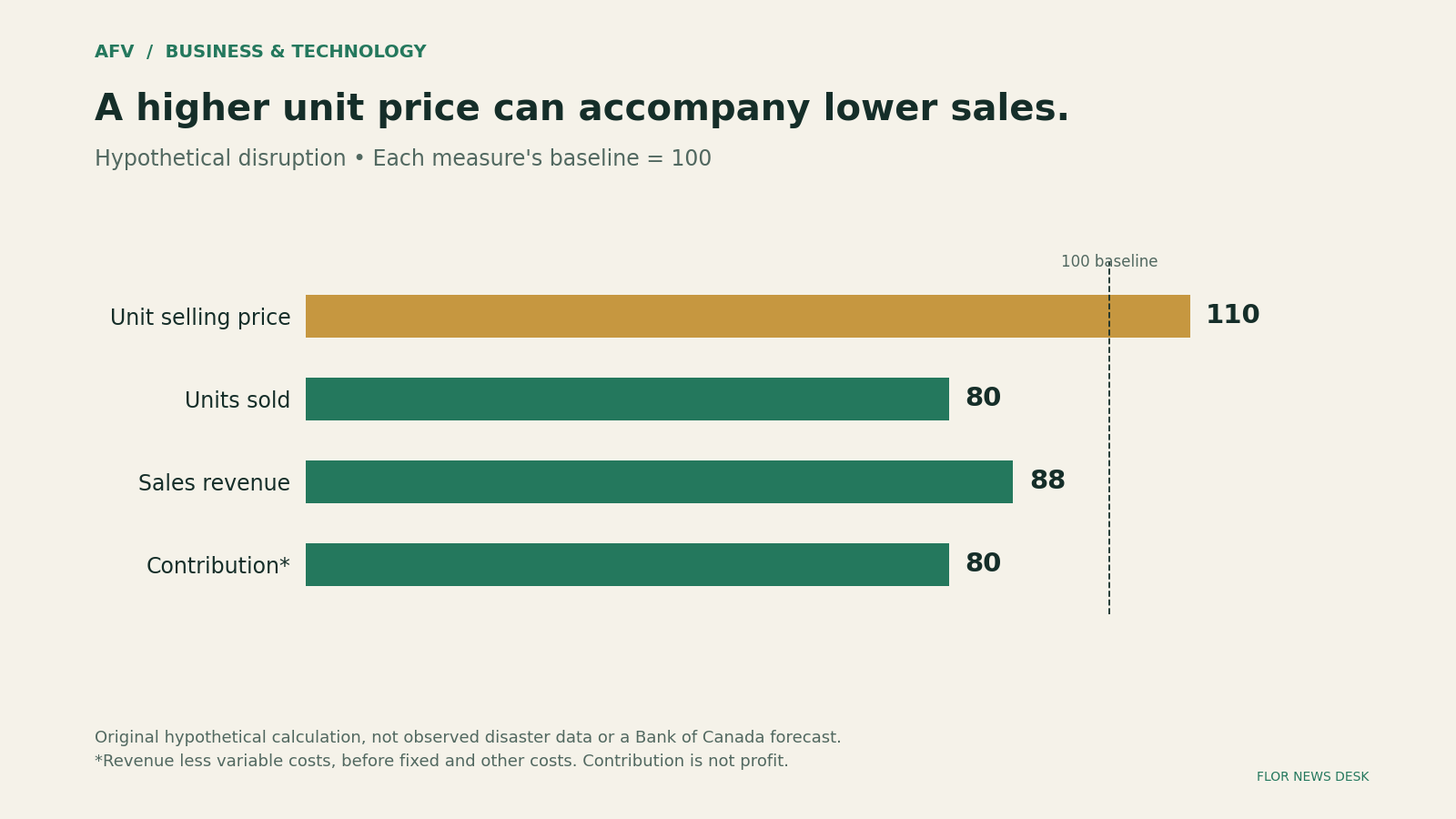
Consider a hypothetical supplier selling 100 units in a period at C$10 each, with a variable cost of C$6 per unit. Sales revenue is C$1,000. Revenue less those variable costs is C$400, before fixed costs and other expenses.
Now suppose a disruption limits sales to 80 units. The selling price rises to C$11, while variable cost increases to C$7. Revenue becomes C$880 and the contribution before fixed costs becomes C$320.
The price rose 10%, but revenue fell 12%. The contribution fell 20%, even though the dollar difference between unit price and variable cost stayed at C$4. Fewer units generated that contribution. The chart shows these original calculations; none is a measured disaster outcome or a forecast from the paper.
Fixed costs, financing expenses and recovery spending are outside this example. C$320 is therefore not a profit estimate. Actual results would also depend on whether orders were delayed, lost or supplied through another route.
Identify the constrained part of the business
AFV's interpretation is that a useful continuity discussion begins with the activity that stops: a delivery route, a machine, a supplier or access to a workplace. A blanket assumption that “prices rise” leaves the quantity that can be delivered unresolved.
A business could examine alternative scenarios for the duration of that constraint, units supplied and cost per unit. Those scenarios would be planning exercises, not probabilities unless there were evidence supporting the probabilities. They should also distinguish postponed sales from permanently lost sales.
The purpose is to keep operational capacity visible beside the price assumption. The central-bank paper supplies a reason to examine output and prices together at the economy level; the hypothetical example illustrates why the same distinction matters when reading an individual business's revenue claim.
Read our editorial standards or send a correction to the editorial desk.