
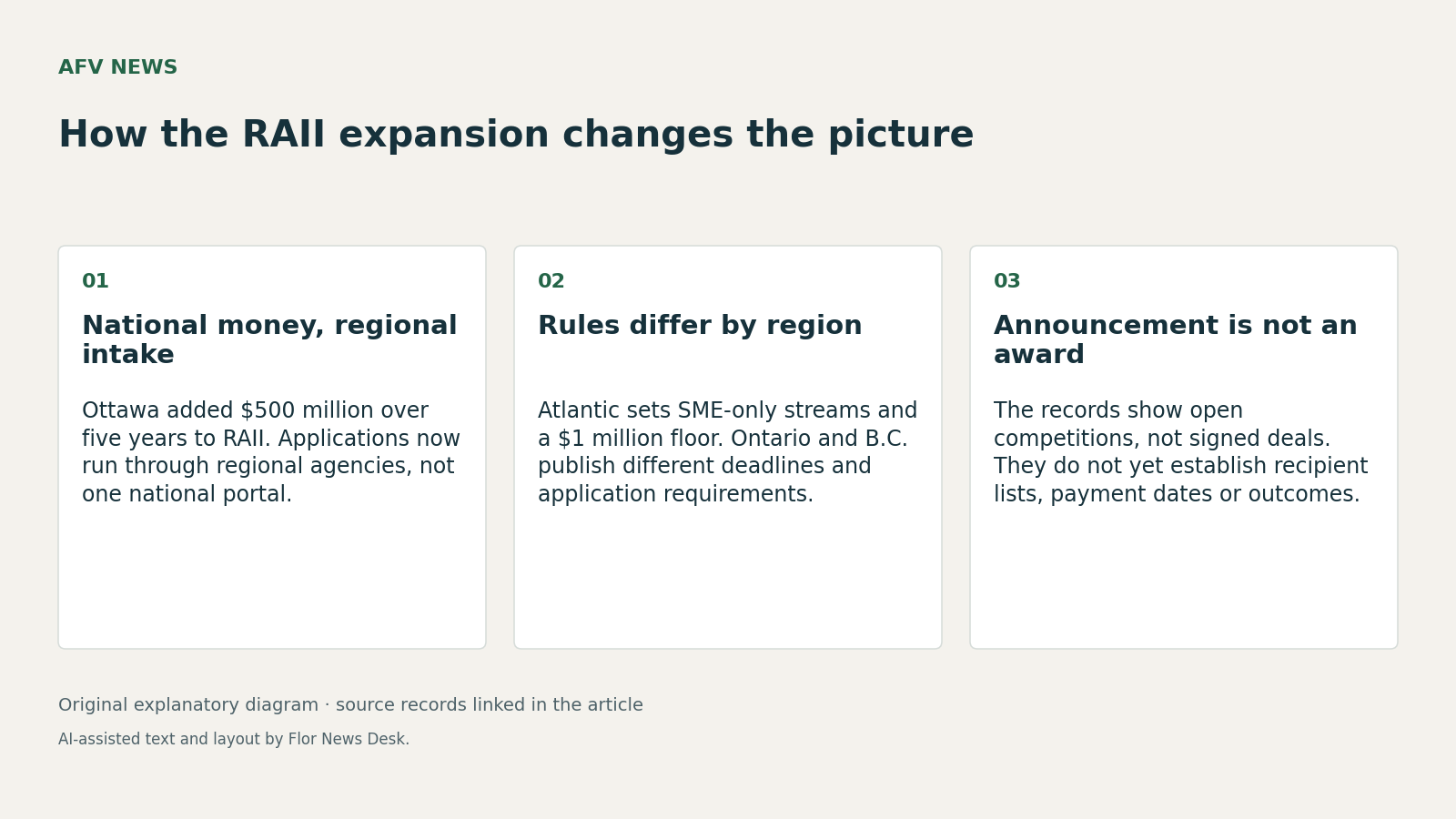
Ottawa’s October 13, 2026 expansion of the Regional Artificial Intelligence Initiative, or RAII, matters because it moved federal AI support from a general policy commitment into time-limited regional competitions. The federal record now shows an additional $500 million over five years for RAII, bringing total federal funding for the initiative to $700 million, with delivery routed through Canada’s regional development agencies rather than a single national intake (ACOA release, FedDev Ontario release, ISED overview).
For businesses, the immediate issue is timing. ACOA says its Atlantic-wide expression-of-interest process closes on November 20, 2026 at 11:59 p.m. ADT, while PacifiCan says its current B.C. intake closes at 12:00 p.m. Pacific on November 23, 2026 (ACOA FAQ, PacifiCan how to apply). FedDev Ontario says applications in southern Ontario are being accepted until January 19, 2027, but adds an earlier November 24, 2026 submission deadline for projects with eligible costs incurred before March 31, 2027 (FedDev Ontario release). The practical implication is that “RAII” is one national banner, but the action window is regional and uneven.
The records also show that eligibility is not uniform. ISED’s overview says RAII support is organized around AI adoption, AI commercialization and scale-up, and AI ecosystem enablement, and that some support can extend to small- and medium-sized enterprises and not-for-profit organizations (ISED overview). But ACOA’s active Atlantic call is narrower: it is limited to SME applicants in two streams, adoption and commercialization, and the Atlantic FAQ says not-for-profit organizations are not eligible in that competition (ACOA FAQ). PacifiCan’s current intake is also limited to businesses, while the page says future intakes are planned for non-profit organizations and SMEs for investments starting after April 1, 2027 (PacifiCan how to apply).
That regional tailoring matters because the program gates can affect who bothers to apply. ACOA says Atlantic projects must be valued at $1 million or more and must target measurable business results such as productivity, competitiveness, commercialization or growth (ACOA release). Its FAQ adds that AI start-ups in the commercialization stream are generally expected to be at Technology Readiness Level 6 or higher, and that support under this call would be repayable, subject to program terms and conditions (ACOA FAQ). PacifiCan’s process also signals a heavier application burden for commercialization files, requiring a supplemental form, detailed budget worksheet, and for technology commercialization projects a technology questionnaire, financial statements and confirmation of other funding sources (PacifiCan how to apply).
The money headlines need the same caution. ACOA says Atlantic Canada is receiving nearly $40 million from the new national funding and that it is delivering more than $55 million under RAII in the region (ACOA release). By contrast, the southern Ontario release does not state a regional RAII allocation at all. It combines the RAII expansion with a separate announcement of more than $1 million for Deep Breathe Inc., which means readers should not treat that company disclosure as proof of a broader southern Ontario RAII award list (FedDev Ontario release).
What the public record establishes, then, is narrower than the political headline. Canada has announced more RAII money, and several regions have opened live intake processes under the broader AI for All strategy described by FedDev Ontario as announced in June 2026 (FedDev Ontario release). What the cited records do not yet establish is equally important: no published national recipient list, no set of signed contribution agreements, no disbursement timetable, and no measured business outcomes from this October 2026 expansion (ISED overview, ACOA FAQ, PacifiCan how to apply).
Read our editorial standards or send a correction to the editorial desk.