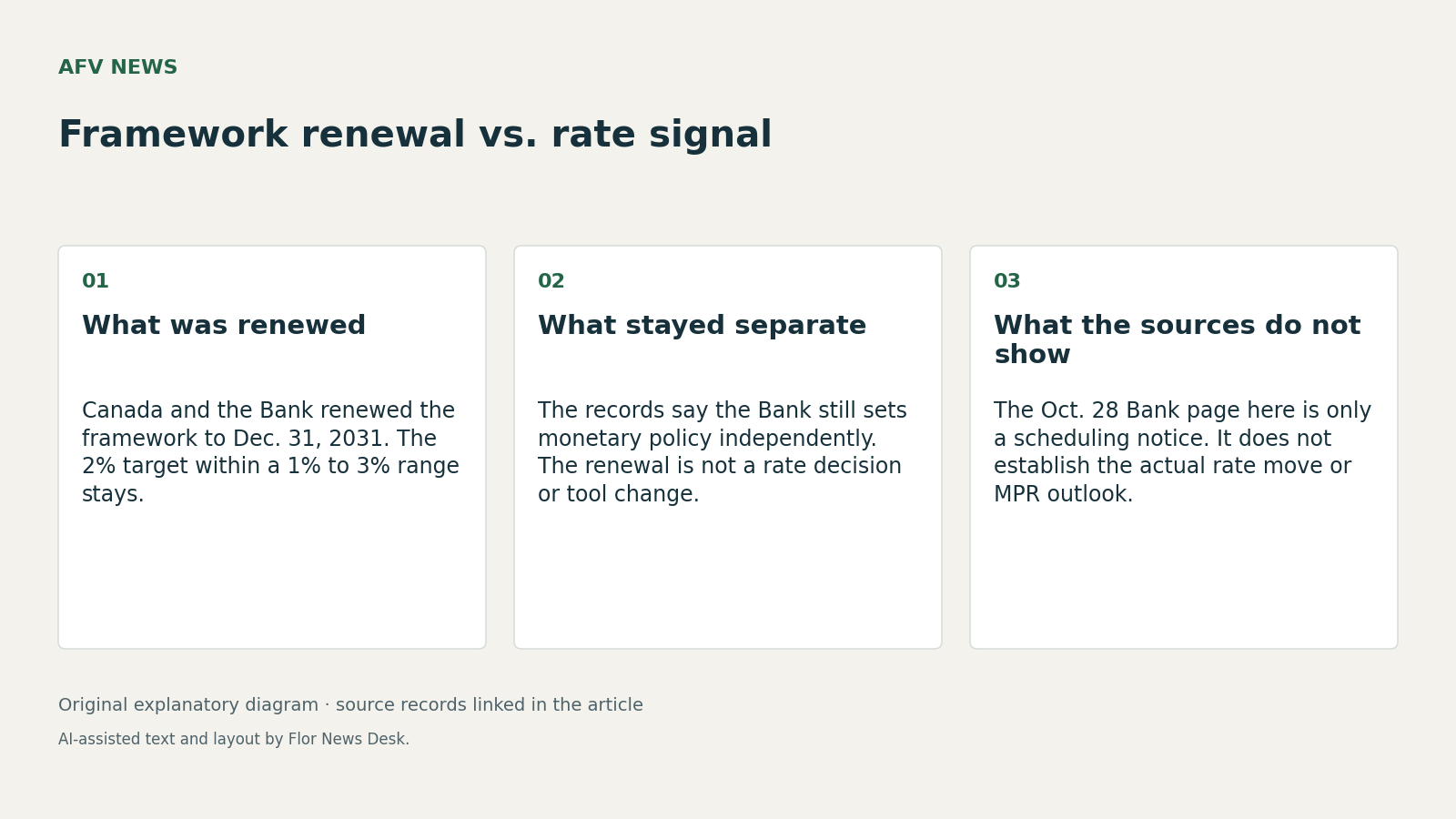
The federal government and the Bank of Canada formally renewed Canada’s monetary-policy framework on November 5, 2026 for the period from January 1, 2027 to December 31, 2031. The joint statement says the 2% inflation target remains the objective, as the midpoint of a 1% to 3% inflation-control range, with inflation still measured by the 12-month change in the consumer price index and with deviations above and below target treated symmetrically. That is a verified policy anchor for the next five years, not a same-day borrowing-cost move. Bank of Canada joint statement Department of Finance posting
What changed is the horizon: businesses now have an explicit federal and central-bank agreement running to the end of 2031. What did not change is at least as important. The same joint statement says the Bank of Canada independently conducts monetary policy within that framework. In the sourced record here, there is no legislative amendment, no new operating tool, no revised inflation band and no announced policy-rate setting attached to the renewal. Bank of Canada joint statement
For Canadian businesses, that makes the main effect one of continuity. If a company uses a long-run inflation assumption in capital budgeting, wage planning or multi-year commercial agreements, the official nominal anchor in the source record has been preserved rather than reset. That does not tell a chief financial officer where rates will be in early 2027. It does mean the basic inflation objective the Bank is meant to return to over time is unchanged through the new term. That is analysis drawn from the continuity of the target, the measurement method and the stated symmetry in the renewed framework. Bank of Canada joint statement
A hypothetical example shows the distinction. A CPI-linked lease or supply contract still points to the same 12-month CPI yardstick named in the framework. But a treasurer deciding whether to lock in short-term financing still needs actual rate and forecast documents, because the November 5 renewal does not itself say policy is tightening or easing. That limit matters for readers trying to turn a constitutional-looking policy statement into an immediate market signal. Department of Finance posting
The source gap on that tactical question is important. The only October 28 Bank record in this source set is a media advisory that scheduled an interest-rate announcement, a Monetary Policy Report release, an early media briefing and a later press conference. By November 6, 2026, that page’s future-tense scheduling language is stale. It does not state the overnight-rate target, any forecast numbers, or even confirm the planned events occurred. So this record cannot support claims about an October 28 rate hike, hold or forecast path. October 28 Bank advisory
That leaves a narrower but still useful business conclusion. The November 5 renewal reduces uncertainty about the policy framework businesses will be planning around through 2031, because the target, band, measure and symmetric treatment were reaffirmed. It does not reduce uncertainty about the next rate decision or the short-run inflation outlook, because those facts are not established in the retrieved October 28 record. For AFV News readers, the practical takeaway is to treat the renewal as a long-horizon anchor and to avoid reading it as fresh evidence on near-term borrowing costs. Bank of Canada joint statement October 28 Bank advisory
Read our editorial standards or send a correction to the editorial desk.