
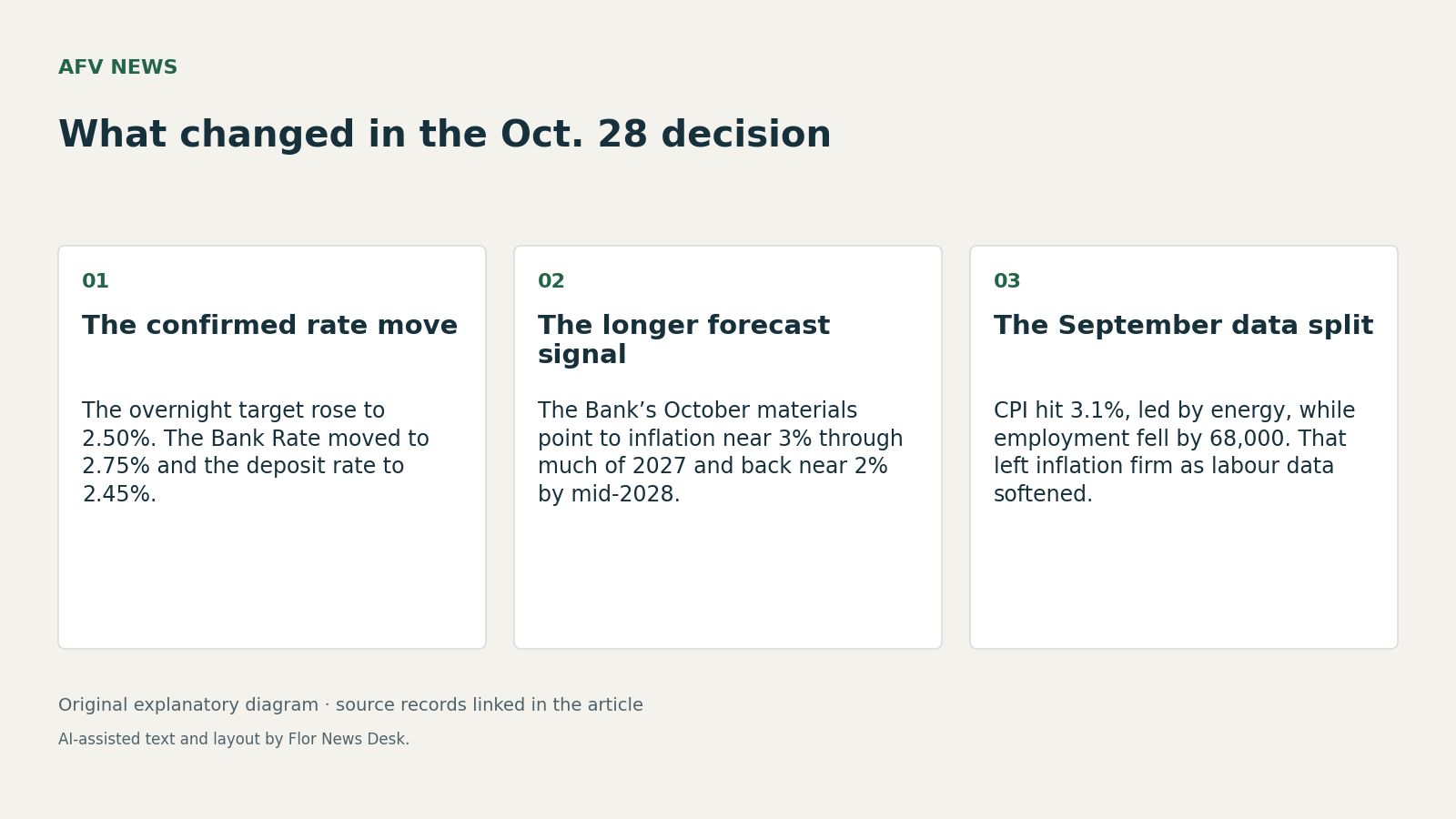
The Bank of Canada’s Oct. 28 decision raised the target for the overnight rate to 2.50%, with the Bank Rate at 2.75% and the deposit rate at 2.45% Bank of Canada rate decision. More important for business planning, the same release said the Bank expects CPI inflation to average 3% in 2027 and return to 2% only in the middle of 2028, while Canadian GDP growth is projected at 1% in 2026 and 2% in each of 2027 and 2028 Bank of Canada rate decision. The quarter-point move matters, but the longer message is a slower path back to target.
That reading is reinforced by the Bank’s October 2026 Monetary Policy Report materials. The Bank’s press-conference page said inflation was higher than previously anticipated, was expected to stay around 3% through much of 2027 and return close to 2% by the middle of 2028 Monetary Policy Report press conference page. The Bank also set the next scheduled overnight-rate announcement for Dec. 9, 2026, and the next Monetary Policy Report for Jan. 27, 2027 Bank of Canada rate decision. What the record establishes is a tougher policy baseline, not a commitment to another increase.
The inflation data available before the decision help explain that baseline. Statistics Canada reported the Consumer Price Index rose 3.1% year over year in September, up from 3.0% in August, while CPI excluding gasoline rose 2.2%, down from 2.4% Statistics Canada CPI release. Energy prices were up 19.0% and gasoline 27.8%, while food purchased from stores rose 1.7% and shelter 1.8% Statistics Canada CPI release. The analytical takeaway is a split picture: headline inflation remained above target, but some non-gasoline pressure looked less intense.
The labour backdrop pointed the other way. Statistics Canada said employment fell by 68,000 in September, the employment rate slipped to 60.6%, unemployment edged up to 6.5%, and manufacturing employment dropped by 13,000 Statistics Canada Labour Force Survey. Average hourly wages among employees still rose 2.3% from a year earlier Statistics Canada Labour Force Survey. Read beside the Bank’s 1% GDP growth forecast for 2026 Bank of Canada rate decision, those figures suggest the Bank tightened even as parts of the real economy were already softer.
For Canadian businesses, that combination changes the planning benchmark more clearly than it defines any single borrowing outcome. The source record confirms the policy-rate increase and the Bank’s forecast horizon, but it does not show how quickly banks, credit unions or private lenders will pass through the change to specific products Bank of Canada rate decision. The practical implication is narrower and still important: firms with short-dated financing decisions, variable-rate exposure or 2027 refinancing needs now have an official inflation path that keeps policy restrictive longer than a simple one-meeting move would imply.
The sector exposure is also more visible in the data than in the Bank’s summary language. Transport-related prices rose 8.4% in September, and energy surged 19.0% Statistics Canada CPI release. Manufacturing simultaneously lost jobs in September Statistics Canada Labour Force Survey. That does not prove margin compression at any individual company, but it does identify where the policy and inflation mix may bite first: businesses that depend heavily on fuel, freight or near-term refinancing. The next confirmed policy checkpoint is Dec. 9, 2026 Bank of Canada rate decision; whether the Bank moves again is not established by the records here.
Read our editorial standards or send a correction to the editorial desk.