
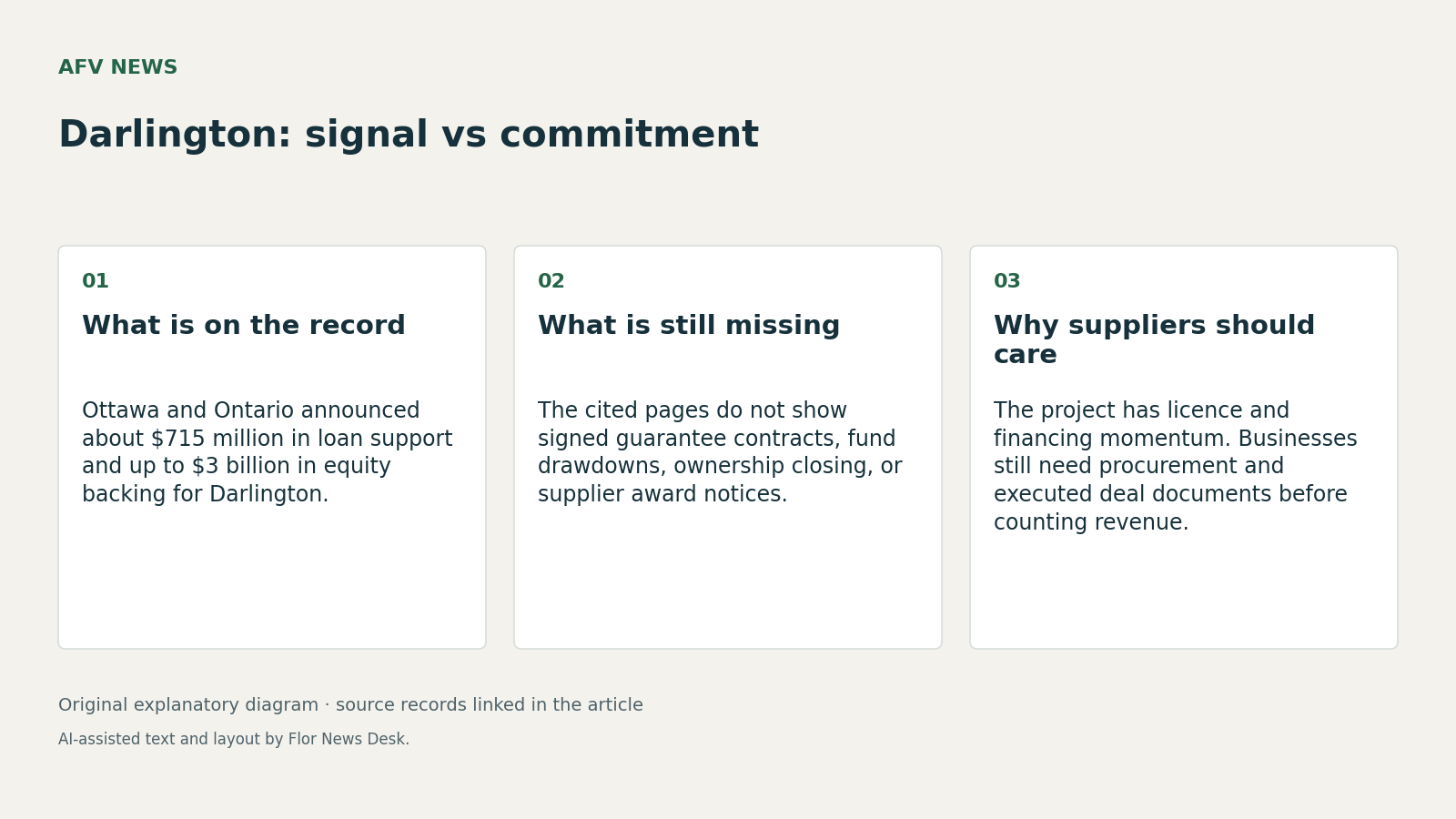
On June 23, 2026, Finance Canada announced a loan-guarantee transaction to support about $715 million in financing so seven Williams Treaties First Nations in Ontario can eventually own a significant minority interest in the Darlington New Nuclear Project (Finance Canada release). That is a material financing step for a Canadian energy project. It is not, by itself, proof that the ownership purchase had closed by November 19, 2026, because the release does not provide the signed guarantee contract, lender identity, draw schedule, close date or exact ownership percentage.
The project record shows why the announcement matters. The federal Major Projects Office page identifies Ontario Power Generation as the proponent in Bowmanville, Ontario, describes the build as the first of four planned small modular reactor units, and lists cost figures of $7.7 billion for the first SMR including common infrastructure and $20.9 billion for all four units (Major Projects Office page). The same page says the Canadian Nuclear Safety Commission granted a licence to construct the first SMR on April 4, 2025, and that the project was referred to the Major Projects Office on September 11, 2025. It also lists a combined equity commitment of up to $3 billion from the Canada Growth Fund and Building Ontario Fund. Together, those items show a project with regulatory clearance and announced public backing, but they still stop short of showing money drawn or construction packages awarded.
That distinction matters because policy announcements are often mistaken for procurement. In this case, the public record supports three things: a licensed project, announced public-equity backing, and announced loan-guarantee support for Indigenous ownership (Major Projects Office page; Finance Canada release). It does not yet show the contract set that many suppliers and advisers need before treating the opportunity as committed business: signed guarantee documents, confirmed payment timing, disclosed ownership closing, supplier tenders, or major construction-contract awards.
Budget 2026 strengthens the policy backdrop, but in broader electricity terms than a Darlington-specific award. The retrieved budget chapter says Ottawa proposes extending the Clean Technology investment tax credit and the Clean Electricity investment tax credit to the end of 2040, expanding Clean Electricity investment tax credit eligibility to certain intra-provincial transmission assets, consulting on a domestic-content bonus, and providing nearly $4 billion over 10 years starting in 2027-28 for electricity infrastructure expansion, renewable energy and priority electricity sector projects (Budget 2026 Chapter 1). Those are signals about intended project economics and supply policy. They are not evidence that legislation has passed or that Darlington suppliers have been selected.
Natural Resources Canada’s Enabling Small Modular Reactors Program helps define what Ottawa has considered fundable work in this space. The page says the program supports research and development in SMR waste management and the creation of SMR manufacturing and fuel supply chains, with projects able to request up to $5 million and generally up to 75 per cent of total costs, or up to 100 per cent for Indigenous-led projects (NRCan program page). But the same page says applications closed on April 21, 2023, even though funding is described as available until March 31, 2027. For businesses, that makes it a guide to program design and eligibility logic, not proof of an open intake.
The practical takeaway is narrower than the political messaging. Darlington now has enough public financing and policy support to justify serious monitoring by Canadian manufacturers, engineering firms, Indigenous economic-development entities and project financiers. But the decision point for committing bid costs should still be tied to harder records: executed financing agreements, public procurement notices, construction awards, and any enacted tax-credit changes or new SMR program windows. Until those records appear, the project looks more like a credible contracting pipeline than booked commercial demand.
Read our editorial standards or send a correction to the editorial desk.