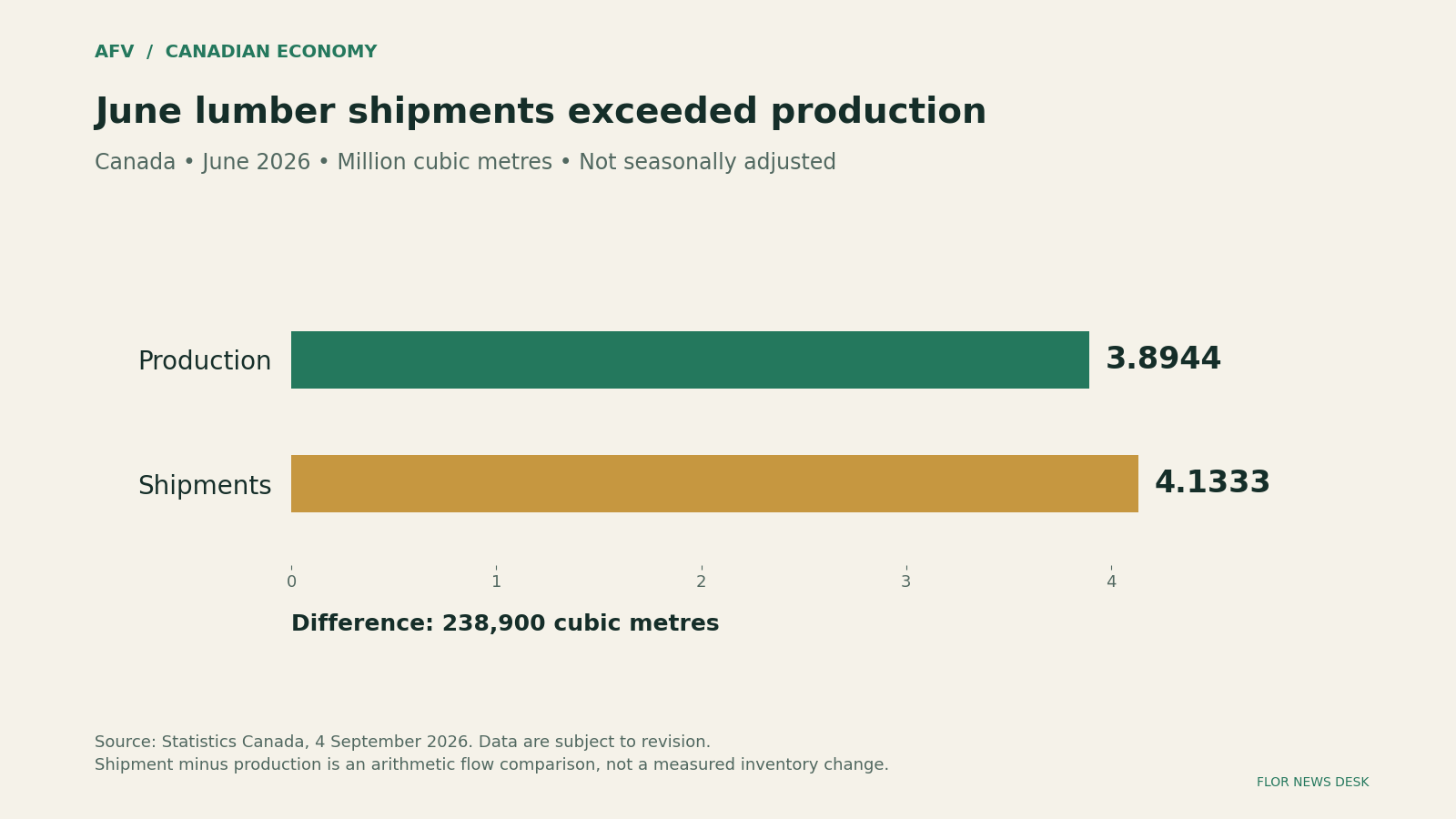
Canadian sawmills shipped 4.1333 million cubic metres of lumber in June, while producing 3.8944 million cubic metres, according to Statistics Canada's September 4 release.
Shipments increased 5.0% from May and production rose 0.2%. Both were lower than in June 2025: shipments by 2.4% and production by 1.9%. The series is not seasonally adjusted and remains subject to revision.
Subtracting reported production from shipments gives a gap of 238,900 cubic metres. That is an arithmetic comparison of two flows, not a published estimate of the change in lumber inventories.
Production and dispatch happen on different schedules
A shipment can leave a yard after the lumber was produced. That means output and dispatches need not be identical in a single month. Establishing why they differ requires a record beyond the two headline totals.
For a simplified hypothetical mill with no purchases, losses or other adjustments, beginning stock plus production less shipments would equal ending stock. If it began with 100 units, produced 80 and shipped 90, it would end with 90. The stock would fall by 10 units even though shipments exceeded that month's production.
That example explains the accounting relationship only. It does not describe the surveyed mills or establish that Canada's inventory changed by the reported production-shipment gap. Actual reconciliation would need consistent stock coverage and any other relevant movements.
Volume does not settle the revenue question
The official release measures physical lumber quantities. AFV has not converted those volumes into sales dollars or profit. A revenue calculation would require prices and the product mix, while an earnings estimate would require costs.
Reading the monthly and annual comparisons
The unadjusted monthly comparison also deserves restraint. A May-to-June change does not remove normal seasonal influences. A year-over-year comparison answers a different timing question, and the two should retain their labels.
For a supplier or customer assessing availability, the useful follow-up evidence would concern the needed product, delivery period and relevant region. The national totals alone do not say whether a particular order is available.
The accompanying chart preserves the source's cubic-metre unit and shows the two June volumes side by side. It does not attribute the gap to tariffs, demand, transport disruption or mill closures; this release does not establish any of those explanations for it.
Read our editorial standards or send a correction to the editorial desk.