

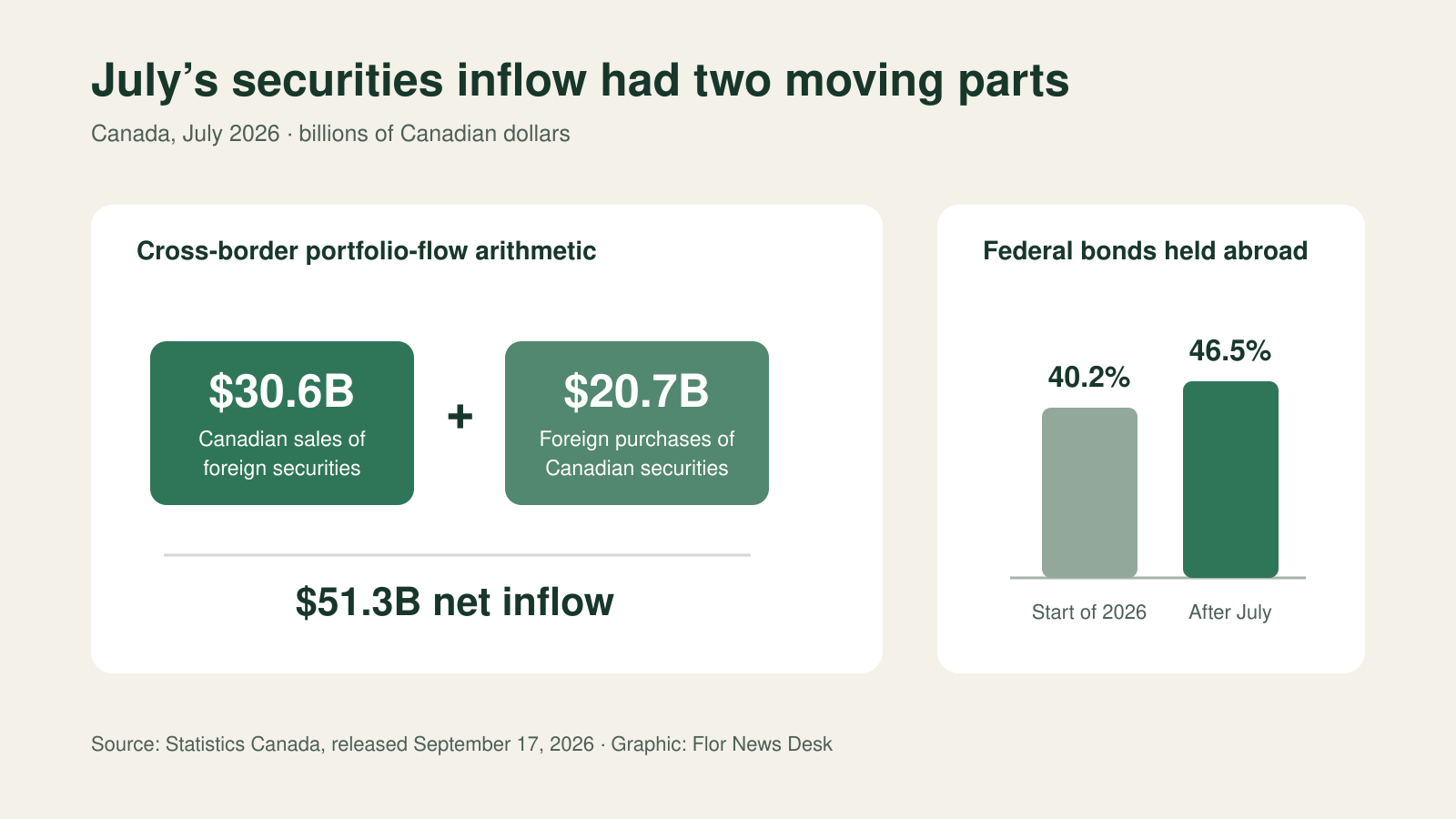
Canada recorded a $51.3 billion net inflow from international securities transactions in July 2026. That headline was not a single wave of foreign money into Canadian companies. It was the sum of two portfolio moves in opposite directions: non-residents bought $20.7 billion of Canadian securities, while Canadian investors reduced their holdings of foreign securities by $30.6 billion. Statistics Canada released the figures on September 17.
The distinction matters because a net flow combines transactions by investors on both sides of the border. When a Canadian investor sells a foreign security, the transaction reduces Canada’s acquisition of foreign assets and contributes to the reported inflow. It does not mean a foreign investor bought a Canadian business.
Canadian sales abroad helped drive the inflow
Canadian investors sold a record $31.0 billion of US shares in July after purchasing $78.1 billion during the first half of 2026. Statistics Canada said the July sales were concentrated in shares of large US technology companies. Canadian investors also reduced their holdings of US government bonds by $5.1 billion, the sixth consecutive monthly divestment. Purchases of US corporate bonds and non-US foreign bonds partly offset those sales.
Foreign buyers concentrated on federal bonds
The foreign-investment side was also concentrated. Non-residents bought $22.7 billion of federal government bonds in July. Their purchases of those bonds reached $104.0 billion from January through July, compared with $13.8 billion in the same period of 2025. The foreign share of outstanding federal government bonds rose from 40.2% to 46.5% over the first seven months of this year.
At the same time, foreign investors reduced their holdings of Canadian money-market instruments by $11.9 billion. The decline included $7.6 billion of private corporate paper and $3.2 billion of federal government paper. That is a different signal from the demand for longer-term federal bonds.
Foreign investors also bought $7.2 billion of Canadian shares, their largest monthly equity investment of 2026. The reported industry detail shows a $7.8 billion purchase of energy and mining shares. Because that sector amount was larger than the overall equity total, activity across the remaining industries was negative on balance. The release does not identify a broad equity purchase across Canadian business.
What the net total does and does not measure
For a company treasurer, investor or policy reader, the useful dashboard therefore has more than one line. The $51.3 billion net inflow describes the balance of cross-border securities transactions. The $22.7 billion federal-bond purchase describes demand for one major class of Canadian debt. The $11.9 billion money-market divestment describes movement out of short-term instruments. None of those figures, by itself, measures direct investment, new factory spending, business lending or the cost at which a particular company can raise capital.
The July figures are monthly transactions and can reverse. They are also subject to revision. A later comparison should use the same Statistics Canada table and data vintage rather than treating one month’s net inflow as a permanent change in investor confidence.
The practical reading is narrower but more informative: July brought funds into Canada through both foreign purchases and Canadian sales abroad, with federal bonds doing most of the work on the foreign-buying side. The headline total is real, but its composition is the business story.
Read our editorial standards or send a correction to the editorial desk.