
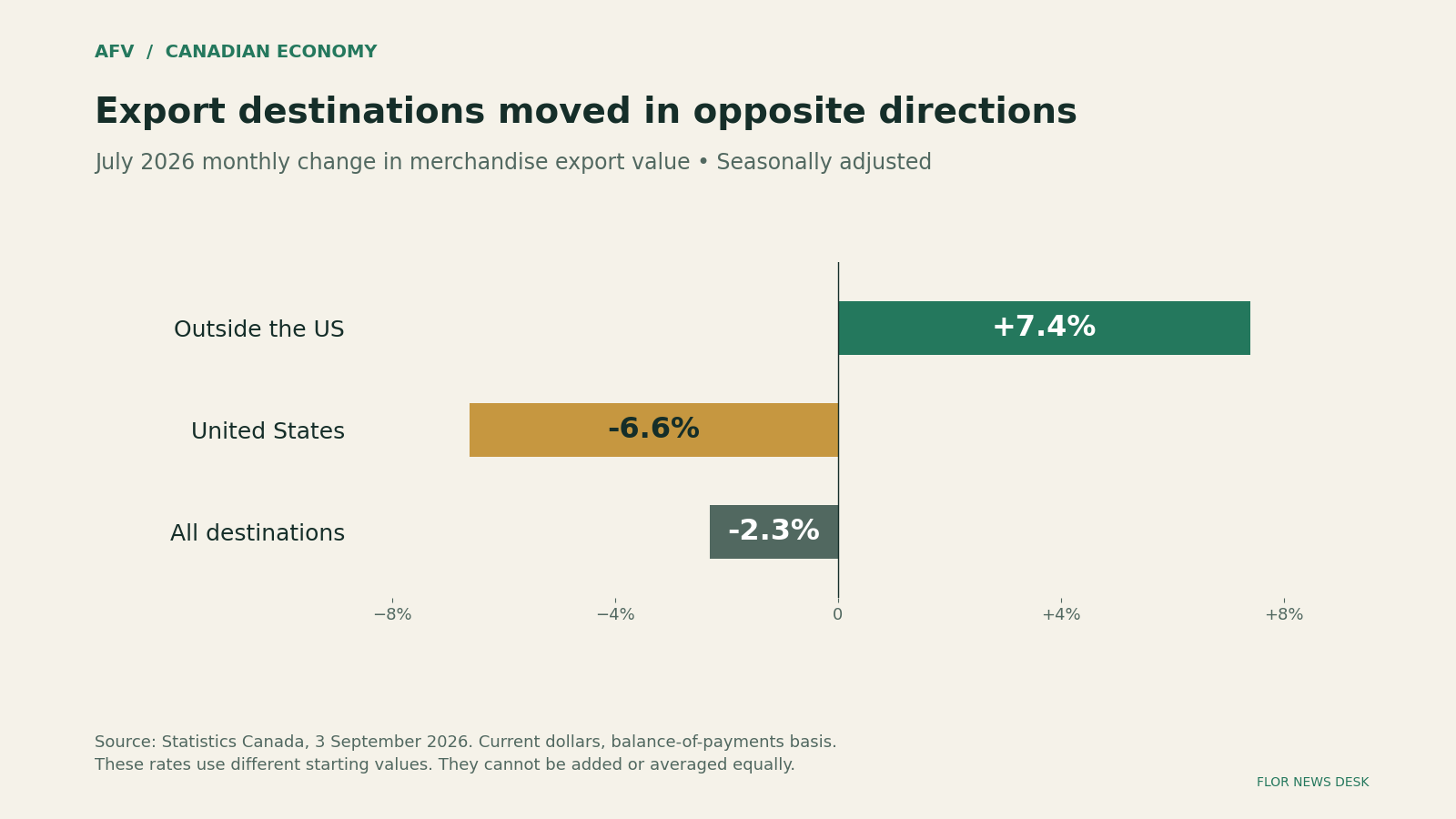
Canadian merchandise exports to destinations outside the United States reached a record C$25.6 billion in July, even as total exports declined 2.3%.
The September 3 Statistics Canada release reports a 7.4% monthly increase in exports to non-US destinations and a 6.6% decline in exports to the United States. The non-US share of total export value reached 33.7%.
The figures are seasonally adjusted and reported in current dollars on a balance-of-payments basis. Total exports also fell in volume terms, by 1.5%. The release identifies several contributors to the non-US increase, including shipments to the Netherlands, China and Germany.
A record for one group can coexist with an overall decline
There is no contradiction between the two headlines. Total exports combine destination groups that can move in different directions. Their percentage changes cannot simply be added or averaged equally, because the groups start from different dollar values.
A small hypothetical example illustrates the point. Suppose one destination group initially buys C$80 and another buys C$20. If the first falls 10% and the second grows 20%, the new totals are C$72 and C$24. Combined exports fall from C$100 to C$96 even though the second group reaches a higher value.
Those are invented figures for explaining aggregation, not a reconstruction of Canada's July result. The graphic instead plots the three actual reported monthly rates separately, without stacking them.
A destination shift needs evidence of persistence
AFV's interpretation is that a record monthly value is a useful signal to investigate, rather than proof that Canadian businesses have permanently diversified their customer relationships. Establishing persistence would require later periods and more detailed information about products and purchasers.
For an exporter, the destination mix of its own confirmed orders is also different from the national trade mix. A company could gain customers in one market while the national value sent there declines, or receive no new business in a growing destination.
Current-dollar values also incorporate price movements. The national volume measure helps distinguish that issue at the aggregate level, but it cannot reveal how many new customer relationships were formed.
The July release therefore supports a specific conclusion: non-US export value set a record while the larger overall measure fell. It does not establish a permanent trade realignment, a change in any named company's customer base or a forecast of next month's sales.
Read our editorial standards or send a correction to the editorial desk.