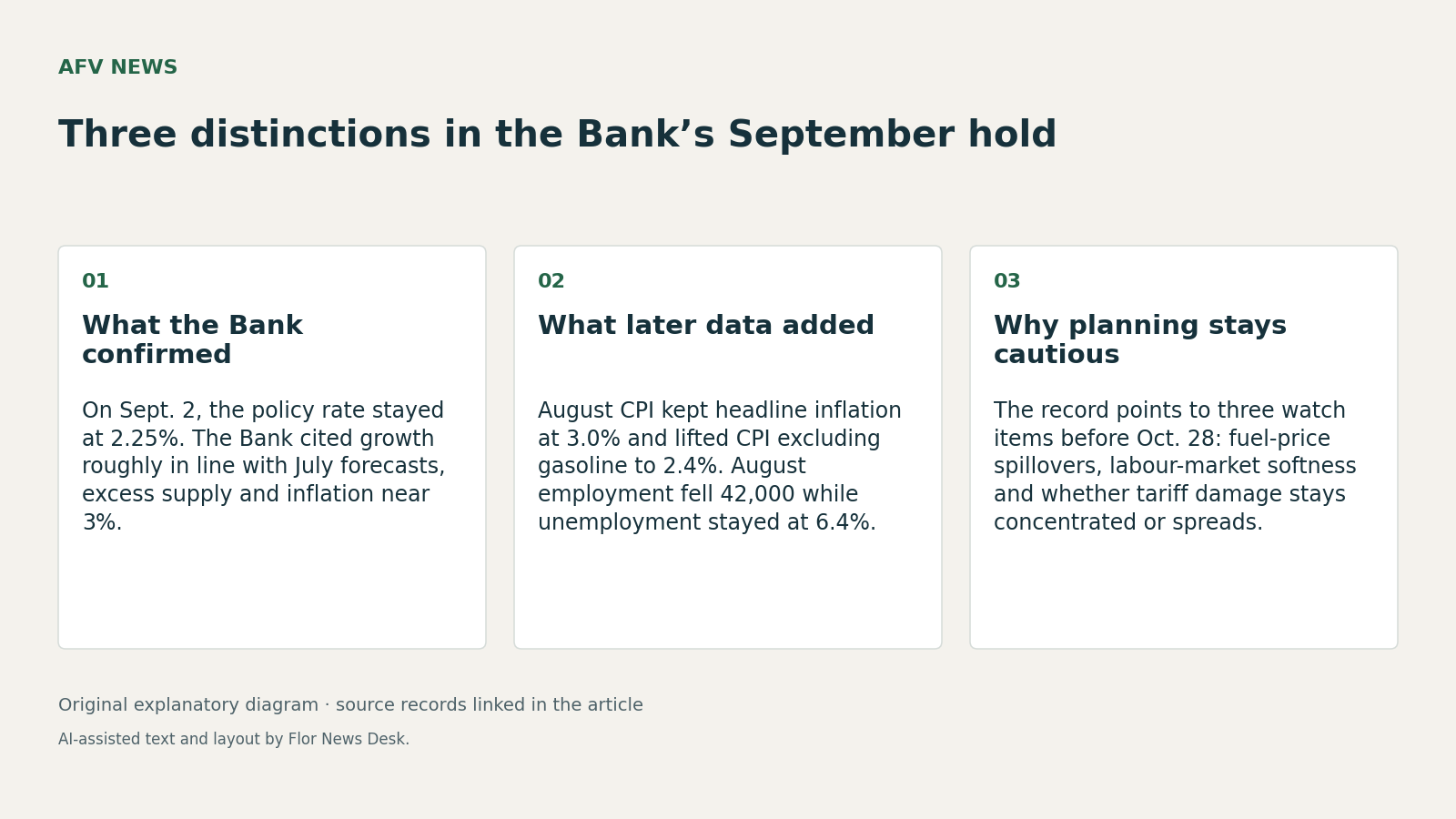
The verified decision is straightforward: the Bank of Canada left its policy rate at 2.25% on September 2, 2026, and its September 16 summary shows Governing Council thought the economy and inflation were evolving broadly as expected in July, even as risks became harder to ignore (Bank of Canada rate decision, Bank of Canada deliberation summary). For businesses and households, that matters less as a prediction of the next move than as a map of what could block faster rate relief.
The Bank’s internal balance was not a simple inflation-versus-growth split. Governing Council recorded second-quarter GDP growth of 3.3%, slightly above expectations, with consumer spending, exports and business investment contributing, while still judging the economy to be in excess supply and the labour market soft (Bank of Canada deliberation summary). The September 2 decision statement made the same tension public: output had improved, but labour demand remained subdued and July unemployment was 6.4% (Bank of Canada rate decision). The practical reading is that stronger GDP alone was not enough to justify a tighter stance, but weaker hiring alone was not enough to produce a cut.
Inflation is where the hold becomes more understandable. Before the September 2 decision, the Bank said CPI had been hovering around 3%, largely because gasoline prices were high, while inflation excluding gasoline was 2.2% and core measures were close to 2% in July (Bank of Canada rate decision). The September 16 summary adds that members saw persistently high gasoline and diesel prices as a bigger upside risk because those costs could spill into other prices (Bank of Canada deliberation summary). August data released later did not settle that debate. Statistics Canada said headline CPI stayed at 3.0%, but CPI excluding gasoline rose to 2.4% and rent inflation accelerated to 2.8% (Statistics Canada CPI, August 2026). That does not prove another rate increase is coming. It does mean the Bank’s concern was not limited to pump prices alone.
The labour data cut the other way. Statistics Canada reported on September 4 that employment fell by 42,000 in August, the employment rate slipped to 60.8%, unemployment held at 6.4% and average hourly wage growth slowed to 2.0% from 2.8% in July (Statistics Canada Labour Force Survey, August 2026). As analysis, those numbers fit the Bank’s excess-supply view better than they fit a case for near-term tightening. But they still do not compel a cut, because the Bank had already said upside inflation risks had increased (Bank of Canada rate decision).
Export-dependent firms face a more specific problem than the national averages suggest. The deliberation summary says new U.S. tariffs covered roughly 5% of Canadian goods exports to the United States and that the macroeconomic effect would likely be modest, even if the hit to affected businesses and workers could be significant (Bank of Canada deliberation summary). The September 2 statement also noted that trade talks had broken down and that Canadian counter-measures had been announced (Bank of Canada rate decision). Statistics Canada’s August labour report adds one concrete sign of uneven exposure: over the previous 12 months, the layoff rate averaged 0.9% in industries dependent on U.S. export demand versus 0.7% in other industries, even as manufacturing added 22,000 jobs in August (Statistics Canada Labour Force Survey, August 2026). In other words, national resilience does not eliminate firm-level trade risk.
That leaves a cautious planning message, not a market call. The only confirmed schedule in the record is that the next overnight-rate announcement is October 28, 2026 (Bank of Canada rate decision). The documents do not establish what retail mortgage or business-loan pricing will do by then. They do identify three tests worth monitoring: whether energy costs keep feeding broader inflation, whether labour softness deepens beyond a flat unemployment rate, and whether tariff damage stays concentrated or starts spreading. Until those questions resolve more clearly, the Bank’s own record reads less like a pivot signal than an argument for waiting.
Read our editorial standards or send a correction to the editorial desk.