
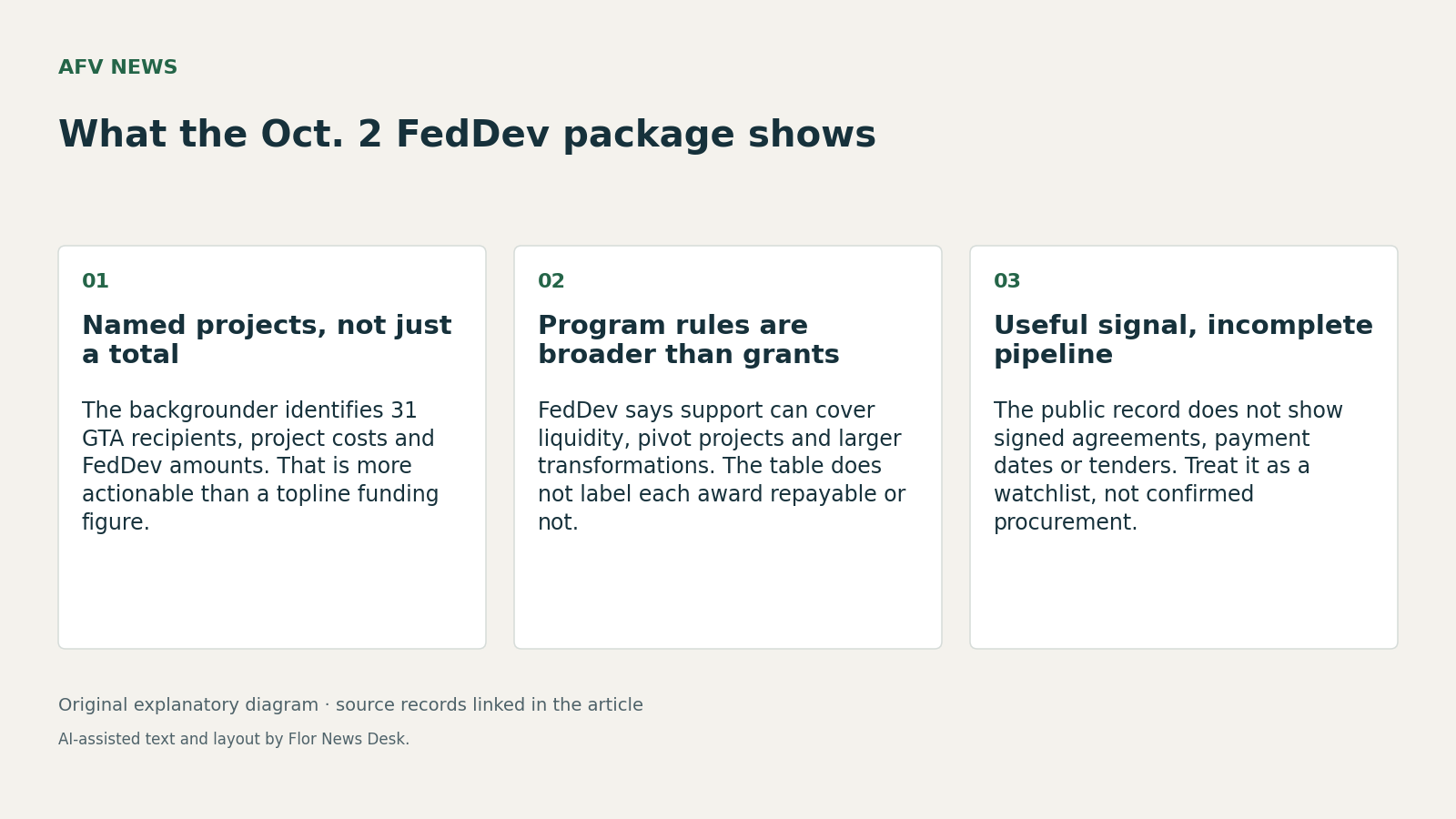
FedDev Ontario’s October 2, 2026 package matters because it turns a broad tariff-response program into a named list of 31 Greater Toronto Area recipients, with project descriptions, total project costs and federal contribution amounts. The agency said it was announcing nearly C$26 million through the Regional Tariff Response Initiative, and the linked backgrounder provides the recipient-level detail that businesses usually need before they can judge where actual projects may emerge (FedDev Ontario release, FedDev Ontario backgrounder).
That is more useful to suppliers than a topline funding announcement because the table points to where capital spending or operational changes are intended. Among the examples recorded in the public material, Oxygen8 Solutions Inc. in Scarborough is listed with a C$15,492,151 project and a C$2,532,000 FedDev Ontario contribution for expanded domestic manufacturing of energy-efficient HVAC and indoor air quality systems. Dy-Tech Inc. in Courtice is listed with a C$14,660,000 project and C$900,000 contribution tied to lithium-ion energy storage system assembly. Pulp Moulded Products Inc. is listed with C$1,500,000 toward a new production line and automated pressing cell, on a C$3,643,000 total project (backgrounder).
The commercial signal is not simply that Ottawa is spending. It is that the disclosed projects cluster around production capacity, domestic supply chains and product pivots. FedDev Ontario said the initiative is meant to support technology adoption, production expansion, supply-chain strengthening and entry into new markets, while its program notes say eligible businesses may access up to C$3 million in combined non-repayable support, including up to C$2 million for liquidity and up to C$1 million for a pivot project; repayable support remains available for larger transformative projects and for some not-for-profits (release).
That distinction matters. The recipient table does not identify, award by award, whether a contribution is non-repayable or repayable. So a listed project can indicate strategic direction without telling outside firms how much of the financing is grant-like, how much may be recoverable, or what conditions attach to the money. For advisers, lenders and equipment vendors, that means the package is better read as a map of intended activity than as a clean measure of project bankability or procurement readiness.
The range of named recipients also suggests the initiative is not confined to one manufacturing niche. The backgrounder includes Sierra Custom Foods Ltd. in Brampton, listed with a C$2,292,654 project and C$600,000 contribution, and notes the company continues under the same name after a 2024 acquisition by Amir Group of Companies. It also includes the Indigenous Tourism Association of Ontario, a Toronto not-for-profit, with a C$580,000 project and C$520,000 contribution for market-readiness and expansion support for Indigenous tourism businesses in southern Ontario (backgrounder). For readers, that widens the supplier watchlist beyond factory equipment alone.
Still, the record has hard limits. As of October 27, 2026, the cited pages do not establish signed contribution agreements, payment dates, procurement notices, start or completion dates, or measured results. They also do not show whether any named company has begun buying equipment or services. FedDev Ontario’s October 2 release ties the package to the federal government’s August 25, 2026 addition of C$1.5 billion to the initiative, bringing the national total delivered by regional development agencies to C$3.45 billion, but the GTA disclosure is most valuable as a recipient-level signal, not proof of implementation (release).
Read our editorial standards or send a correction to the editorial desk.