
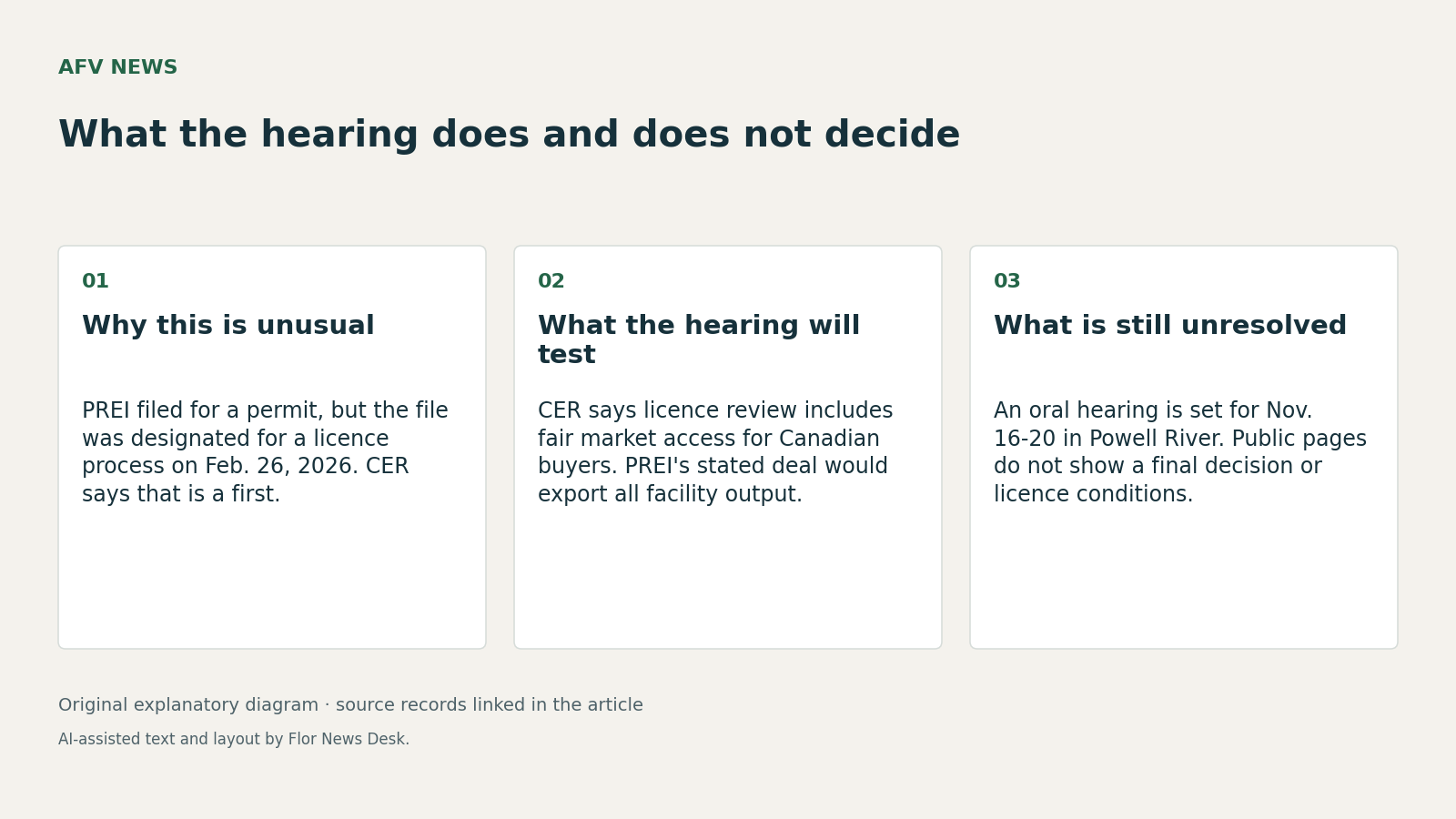
The Canada Energy Regulator has set a Nov. 16 to 20, 2026 oral hearing in Powell River for Powell River Energy Inc.'s export application, turning a long-running filing into a live test of how Canada handles long-term electricity contracts that reserve all generation for a U.S. buyer. The regulator says this is the first time its Commission recommended moving an electricity export application from the usual permit route into a licensing procedure, with the Governor in Council making that designation on Feb. 26, 2026. CER feature page project page
The underlying commercial request is unusually long. The project page says PREI applied on Aug. 15, 2025 for a 30-year contract-specific export authorization tied to its Powell Lake and Lois Lake hydroelectric facilities in Powell River, British Columbia, with combined rated capacity of about 85 megawatts. The same page says PREI entered into an agreement with BR Pacific Hydro Power LLC, a U.S. affiliate, to export all electricity generated at the two facilities. project page
That matters because the CER says an electricity export licence review is not only about technical permission to move power across the border. Its stated criteria include effects on other provinces and fair market access for Canadian purchasers that have expressed interest. On the facts now public, the central issue is less whether PREI can generate electricity and more whether a 30-year all-output commitment can coexist with the regulator's access test for Canadian buyers. That is analysis, but it follows directly from the regulator's criteria and the project's stated contract structure. CER feature page project page
The public record also shows why this has become more than a paper filing. The CER says BC Hydro and Tla'amin Nation are intervenors, and that the City of Powell River was added as an intervenor in June 2026. Separately, the project page says more than 2,600 written submissions had been received as of Nov. 13, 2025. Those facts show broad interest, but they do not establish who has the stronger legal or economic case. Volume of submissions is not the same thing as a Commission finding. CER feature page project page
For businesses and local governments, the immediate change is procedural but still important. A hearing date now exists, and the CER says a livestream is planned on its website. What the public pages do not show, as of Nov. 3, 2026, is any final Commission decision, any licence conditions, or any hearing outcome. The project page's title still refers to an export permit while its body records the shift to a licensing procedure, which is a reminder to separate the original application from the current review track. CER feature page project page
The broader regulatory context supports treating this as a meaningful precedent, not a clerical change. In preparatory documents for an April 23, 2026 parliamentary appearance, the CER listed planned 2026-27 spending of $119.4 million, including $29.6 million for Energy Adjudication, $11.0 million for Engagement, and $10.6 million in transfer payments to support Indigenous Peoples and stakeholder participation in CER activities. That budget document says nothing about whether PREI should win approval, but it does show that contested energy cases are being handled inside a regulator built for formal adjudication and participation, not only routine processing. CER governance package
What to watch after Nov. 16 is therefore specific: whether the Commission treats a 30-year, all-output export arrangement as compatible with fair market access for Canadian purchasers, and whether any eventual licence is narrowed by conditions. The public record before the hearing establishes the timetable and the governing questions. It does not establish the answer.
Read our editorial standards or send a correction to the editorial desk.