
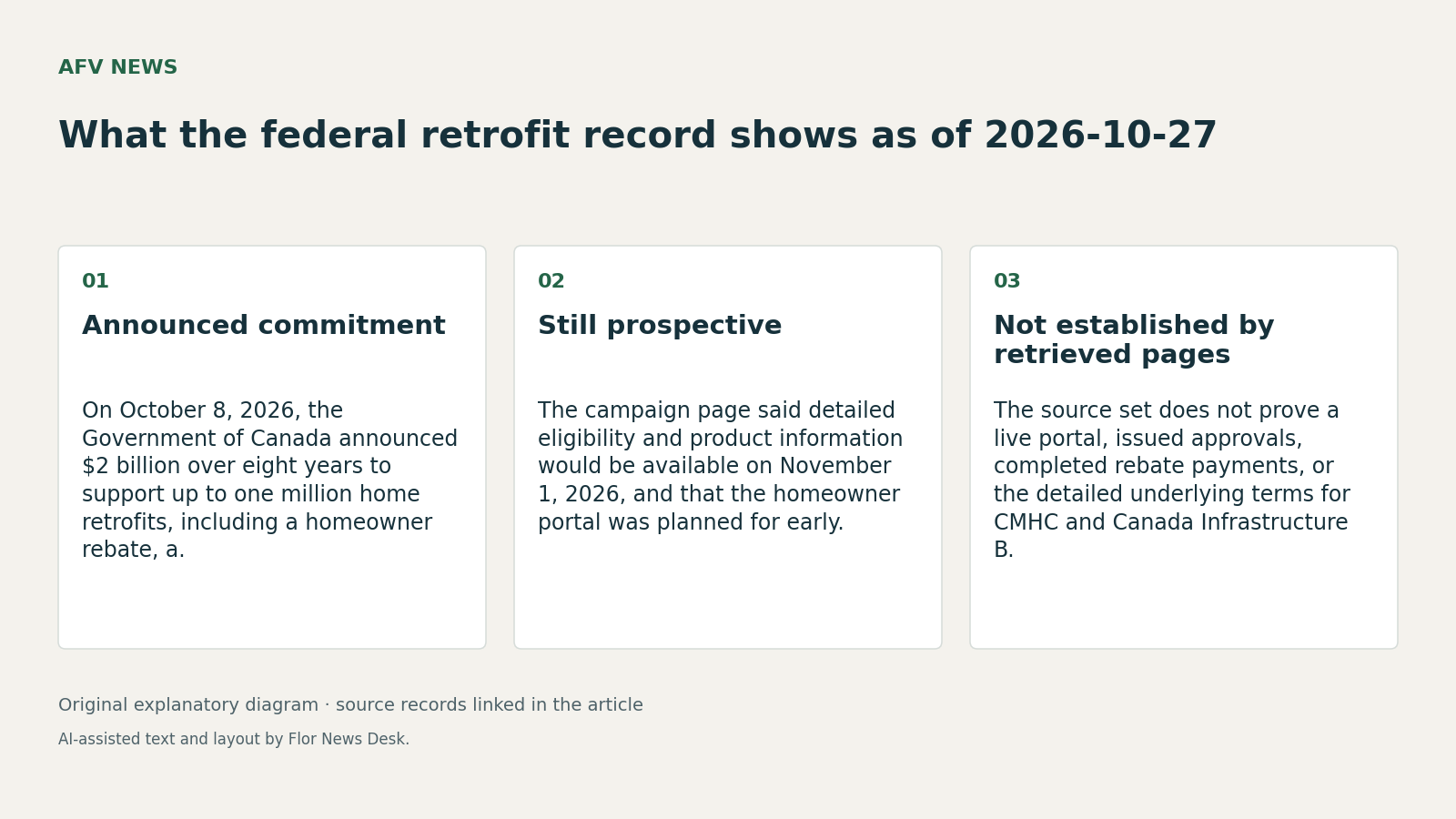
On October 8, 2026, the Government of Canada said it would invest $2 billion over eight years to support up to one million home retrofits, a scale large enough to matter for HVAC contractors, heat-pump suppliers, building-envelope firms and rental owners if it is carried out as described in the federal record (Environment and Climate Change Canada backgrounder). What that record proves today is an announced commitment and a proposed delivery structure, not that money is already flowing or that businesses can treat federal timing as operational fact.
The October 8 backgrounder names three main channels. It says a National Heat Pump Rebate would support up to 820,000 homeowners installing eligible electric cold climate air source heat pumps. It also says the Canada Mortgage and Housing Corporation is expected to support retrofits in up to 250,000 rental housing units over eight years, while the Canada Infrastructure Bank is targeting up to an additional 30,000 residential units in Multi-Unit Residential Buildings. A separate measure would invest nearly $110 million over three years starting in 2027-28 to renew the Deep Retrofit Accelerator Initiative (Environment and Climate Change Canada backgrounder).
A later federal release on October 23 restated the apartment and multi-unit portion as at least 280,000 units over eight years, combining CMHC and CIB channels (Innovation, Science and Economic Development Canada release). But the source set does not fully itemize how the headline $2 billion relates to the homeowner rebate stream, the leveraged CMHC and CIB channels, and the separate nearly $110 million Deep Retrofit Accelerator renewal. That limits how precisely businesses can map the funding stack from these pages alone.
For contractors and retailers, the most immediate demand signal is the heat-pump rebate. The backgrounder says eligible below-median-income households could receive up to $10,000, while other eligible homeowners could receive $2,000, with one rebate per person and no pre- or post-installation energy audit required (Environment and Climate Change Canada backgrounder). The campaign page adds that the online portal is planned for early 2027, that the retroactivity period would start on November 1, 2026, and that more details on eligibility, eligible products and application steps would be available as of November 1, 2026 (One million home energy retrofits page). As of October 27, 2026, those remain future milestones in the retrieved record.
One factual limit in the cross-check matters. The October 8 backgrounder says the new program would confirm approval within 24 hours and that payment would be approved within five days after receipts are submitted. The October 16 Employment and Social Development Canada release repeats the online-portal, no-audit design and the 24-hour approval claim, but not the five-day payment timeline (Environment and Climate Change Canada backgrounder; Employment and Social Development Canada release). The retrieved pages do not establish that the portal is open, that approvals are being issued, or that any rebate payments have occurred.
For landlords, developers and lenders, the bigger caution is that part of the package depends on financing structures rather than a straightforward grant. The backgrounder says CMHC would work through its existing mortgage loan insurance framework and leverage private capital, while the CIB would use its existing government allocation, meaning no new federal funding is required for that channel (Environment and Climate Change Canada backgrounder). No directly retrieved CMHC or CIB program pages in this source set provide underlying terms, agreements or disbursement schedules.
The practical reading for Canadian businesses is that Ottawa has created a meaningful market signal, but not yet a fully evidenced operating program. Firms can prepare by checking installer credentials, receipt and documentation systems, and multi-unit project pipelines. They still need to watch the November 1, 2026 detail release and the planned early 2027 portal before treating federal approvals or payment timing as cash flow already in hand (One million home energy retrofits page).
Read our editorial standards or send a correction to the editorial desk.