
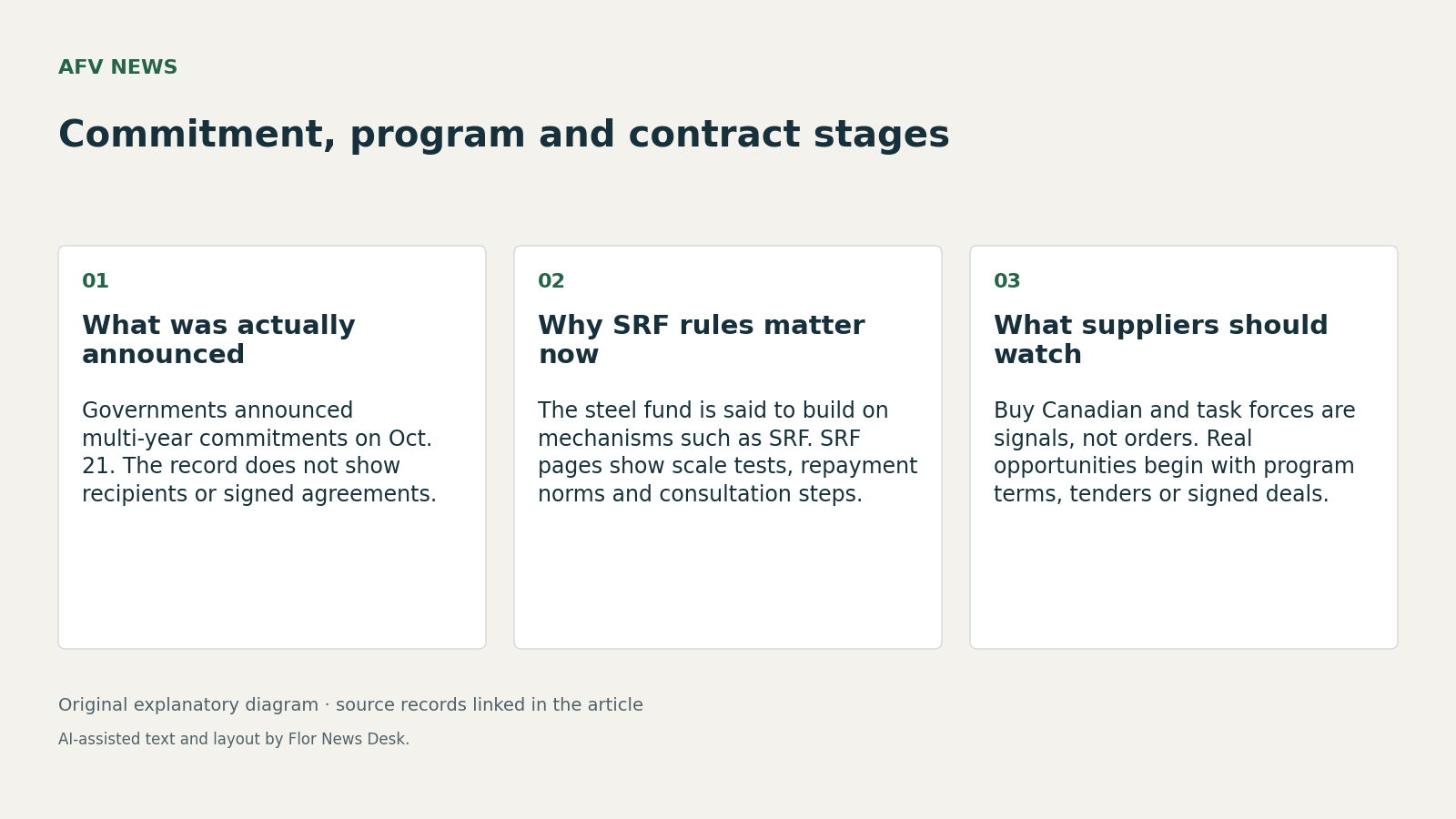
Ottawa and Queen’s Park moved the policy debate from tariff relief to industrial financing on October 21, 2026, when a federal backgrounder set out an $8.7 billion package for Ontario industries facing U.S. tariffs and longer-term competitiveness pressures (ISED backgrounder). For businesses, the immediate takeaway is not that money is flowing already. It is that governments have identified which sectors they want to back, at what scale, and through which broad mechanisms. The same record does not show recipients, signed contribution agreements, application windows or payment dates.
The clearest new commitment is the proposed Joint Steel Action Fund: $3.55 billion from the federal government and $1.67 billion from Ontario over five years, according to the October 21 backgrounder. The same document also points to Buy Canadian and Buy Ontario procurement policies for steel, plus a Canada–Ontario Steel Task Force meant to advise on implementation and competitiveness issues (ISED backgrounder). That is a strong demand and financing signal, but it is still one step removed from a tender, a supply contract or a contribution agreement.
Why the Strategic Response Fund matters is narrower, but important. The backgrounder says the steel fund will build on existing mechanisms such as the Strategic Response Fund, and the SRF overview says the program is for large-scale projects tied to resilience, supply chains and jobs, including steel and automotive activity. It tells companies to review requirements, check eligibility and request a consultation (SRF overview). Analysis: that makes the published SRF rules the best available guide to how at least part of the announcement could operate, while falling short of proof that every October 21 commitment will use unchanged SRF terms.
Those standing rules set a high bar. ISED’s funding-conditions page says the minimum SRF contribution is $10 million and the project must have at least $20 million in total eligible supported costs. It also says contributions are repayable by default, with final repayment terms determined case by case after due diligence, and that non-repayable support is reserved for certain projects showing significant benefits for Canadians. The same page says governments consider stacking from all levels when setting support (SRF funding conditions). That matters because firms should not read the steel announcement as evidence of fast grants for any project size.
The FAQ adds two practical points. First, ISED says SRF focuses primarily on projects larger than $20 million, with project-based reimbursement of a portion of eligible costs rather than automatic upfront cheques. Second, it says tariff-response files can include pre-development work such as front-end engineering and design for retooling and market-diversification projects, and it encourages early consultations (SRF FAQ). For suppliers and project developers, that suggests preparation work may matter before any full capital decision is made.
The rest of the October 21 package follows the same pattern: large commitments first, implementation detail later. The backgrounder says governments will add $2.5 billion over two years for large automotive capital projects, with up to $1.5 billion federal and up to $1 billion provincial, and it says Ottawa will commit up to $1 billion over three years for road infrastructure tied to Ring of Fire critical-mineral development (ISED backgrounder). None of that, on the retrieved record, establishes who gets funded first, when procurement opens, or how fast construction can start.
The practical reading for Canadian manufacturers is straightforward. Treat the October 21 package as a serious pipeline signal for large steel, auto and infrastructure projects, especially where a business can show a tariff-response case, a credible capital plan and procurement-ready scope. But treat Buy Canadian language, task forces and headline dollar figures as commitments awaiting program terms, contribution agreements or tenders. The SRF pages are also older than the October 2026 announcement, so they show standing rules, not a confirmed launch schedule for the new Canada–Ontario package (SRF overview; SRF funding conditions; SRF FAQ).
Read our editorial standards or send a correction to the editorial desk.