
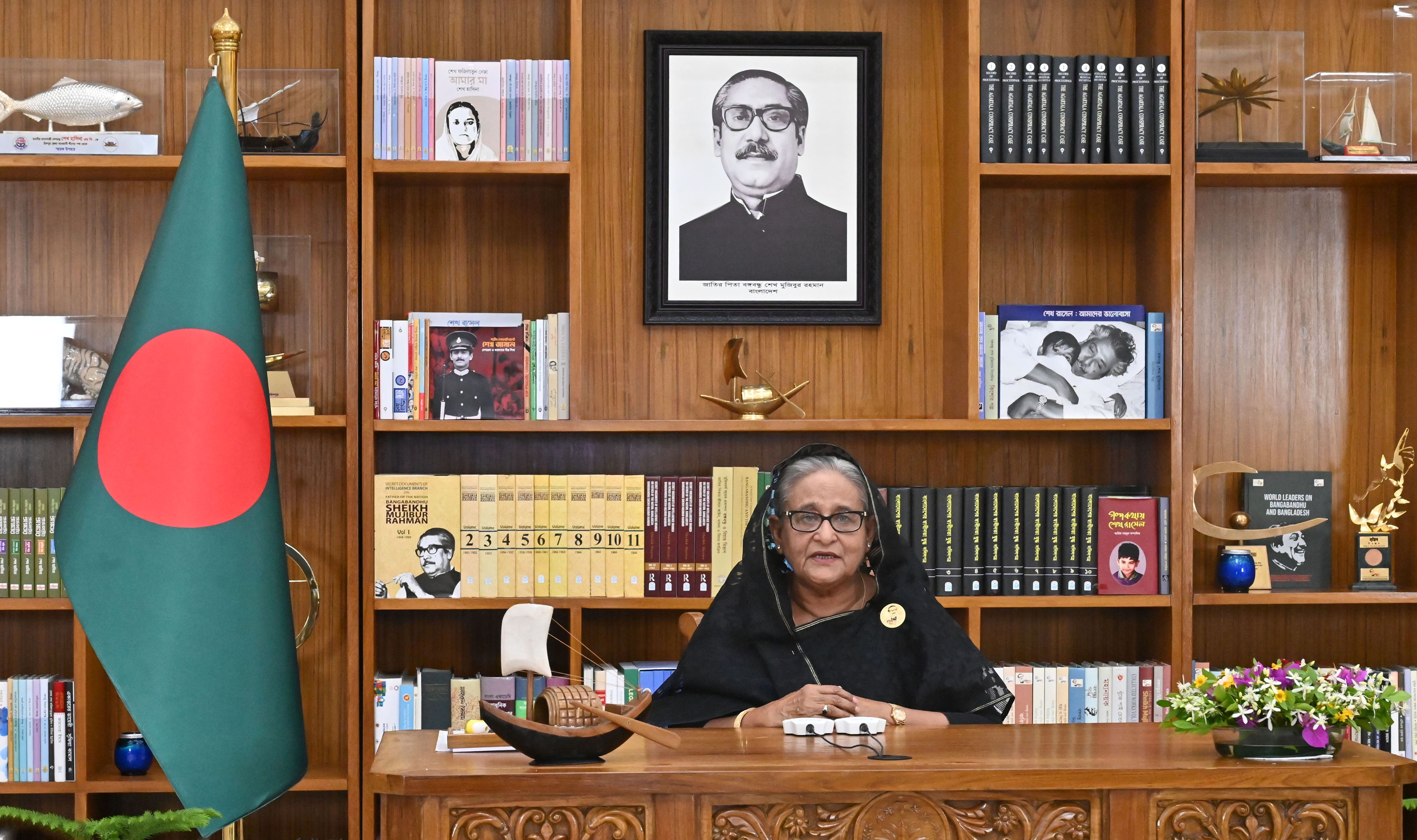
Former Bangladesh prime minister Sheikh Hasina has reaffirmed her pledge to return to her country by December 2026, saying she is prepared to face imprisonment to continue her political work, even as she rejects the tribunal proceedings that resulted in her death sentence, according to a supplied interview transcript.
In a transcript of an NDTV telephone interview supplied to AFV News, Hasina described her return as a commitment to Bangladesh and its people. But she did not identify an agreed route home, disclose a specific arrival date or confirm the substance of any negotiations with the Bangladeshi or Indian governments.
The interview ranged beyond her personal future. Hasina said she was working to restore the organizational strength of the Awami League despite restrictions on its political activities, invoked her family's assassination and her own earlier periods of imprisonment, and argued that countering extremism required both stronger security institutions and closer cooperation across South Asia.
The transcript was supplied on September 22, 2026 and identified as an interview broadcast that day. AFV News has not independently verified the recording or broadcast date. The account below reports the statements in that transcript; separately sourced background on the tribunal ruling is identified in the legal section.
A return pledge, but no disclosed agreement
“I have made a solemn commitment to return to my homeland by December 2026,” Hasina said.
The interviewer opened by asking whether she had initiated official or backchannel communications with either government, what had been discussed and how she intended to return.
Hasina referred generally to discussions and speculation, but her answer did not establish that either government had agreed to facilitate her journey or offer any particular legal or security arrangement. She emphasized that she wanted a peaceful, lawful return that respected Bangladesh's sovereignty and the rule of law.
Presenting herself as a citizen with a right to go home, she argued that no Bangladeshi law could justly prevent her return. That was her position in the interview, not a legal determination resolving the consequences of the outstanding sentence.
She also rejected suggestions that she had abandoned Bangladesh. The circumstances of her departure, she said, had been beyond her control. She linked her wish to return to what she described as a lifetime of work for the country's development and its people's economic wellbeing.
Her answer placed the emphasis on finding a way back that protected national and public interests, rather than reconsidering whether she intended to return. The practical arrangements, however, remained unspecified.
Prepared for prison while rejecting the verdict
Asked directly about the possibility of arrest and imprisonment after returning to Dhaka, Hasina said she was prepared to accept legal consequences if they were the price of continuing her political struggle and serving Bangladesh's people.
Her willingness to face imprisonment did not amount to accepting the tribunal's findings. She described the death sentence as “politically motivated and unjust,” rejected the proceedings and their outcome, and accused the administration formed after her departure of acting unconstitutionally and out of vengeance.
Those were Hasina's allegations. The interview did not include a response from the tribunal or the Bangladeshi authorities to those accusations.
She insisted that she expected the law to be applied fairly in her own case and demanded legal protection for her rights as a citizen throughout any judicial process. She said fear or intimidation would not deter her from political activity, presenting her intended return as consistent with her stated commitments to democracy, justice and public welfare.
Background to the ruling: The UN human rights office's November 17, 2025 statement, reproduced by the Austrian Red Cross's ecoi.net service, described verdicts against Hasina and a former home minister on crimes-against-humanity charges arising from the suppression of protests in 2024. It emphasized accountability and remedies for victims, while stressing due process and fair-trial standards, particularly because the proceedings took place in the defendants' absence and resulted in capital punishment. The office said it had not been privy to the conduct of the trial and reiterated its opposition to the death penalty in all circumstances. That statement is background to the case, not a response to this interview.
Family assassinations and the justice system
Hasina framed her demand for a fair process through her account of the killings of her father, Bangabandhu Sheikh Mujibur Rahman, and other family members on August 15, 1975.
She said the victims included her mother, three brothers, two sisters-in-law, an uncle and other relatives, describing 18 family members as having been killed. She and her sister were in Germany at the time, she recalled, and she was unable to return to Bangladesh for six years.
According to her account, she returned in 1981 after the Awami League elected her as party president while she was abroad. She said that after coming to power in 1996, she initiated the prosecution of her father's killers, following a period in which an indemnity arrangement had blocked their trial.
Hasina attributed that protection to the military-era leadership of Ziaur Rahman. She said the case was pursued under Bangladeshi law and described the elapsed time from the killings to a final verdict as more than three decades, including more than 13 years devoted to the legal process itself.
She cited that experience as the basis for her professed confidence in Bangladesh's justice system and for her demand that the same principle of fair treatment apply to her. Her argument distinguished her stated belief in the country's legal institutions from her rejection of the particular tribunal proceedings against her.
Rebuilding the Awami League from exile
The interviewer asked how Hasina intended to revive the Awami League while it remained barred from active politics, and whether she would personally lead efforts to rebuild it as an opposition force.
Hasina said she was already working to strengthen the party's organization and reconnect with supporters and party workers across Bangladesh. She made clear that she envisaged a central role for herself rather than a withdrawal from political leadership.
She described the Awami League, founded in 1949, as the party that led Bangladesh to independence and defended its democratic aspirations. That description reflected her account of the party's record and purpose.
Preserving her father's historical legacy was also central to her answer. She said she wanted Sheikh Mujibur Rahman's contribution to be respected and linked the party's revival to the restoration of democratic governance and protection of Bangladeshis' rights and dignity.
The interview did not set out a detailed organizational timetable, identify a legal route for overturning the restrictions on the party or describe a specific electoral strategy. It established her intention to remain involved and rebuild connections, rather than a fully developed public plan for restoring the party's political participation.
Earlier imprisonment invoked as evidence of resolve
Hasina recalled being detained with her mother during Bangladesh's 1971 independence struggle, after her father's arrest. She said she was pregnant with her first child at the time and that her son was born in captivity.
She also described her political work after returning in 1981 as a movement against military rule and for democratic rights. Referring to repeated arrests during the 1980s, in 1990 and again in 2007, she said earlier periods of detention had not stopped her political activity.
These recollections formed part of her answer about the Awami League's future. She used them to argue that imprisonment and difficult circumstances had not previously ended her involvement and would not, in themselves, make her abandon her present plans.
Security warning accompanied by a civil-liberties message
Asked about the risk of terrorist and extremist networks gaining ground in Bangladesh, Hasina characterized the threat as grave and said it should not be underestimated.
She defended her own government's approach, saying preventing the country from becoming a haven for such networks had been a priority while she was in office. For the present, she advocated stronger intelligence capabilities, effective law enforcement and community engagement to counter radicalization.
She also said security measures needed to be balanced with civil liberties. Her stated objective was to preserve peace and stability within Bangladesh and across the wider region, rather than treating domestic security as an isolated concern.
The transcript contains no specific intelligence assessment, named militant network or newly disclosed incident supporting her warning. Her remarks were a political assessment and a statement of preferred policy.
The question included a comparison with Pakistan and referred to closer ties between Pakistan and Bangladesh. Hasina's answer did not directly endorse that comparison. Instead, she emphasized that extremist networks and ideologies cross national borders.
An argument against isolating Bangladesh
Hasina said isolating Bangladesh from its South Asian neighbours would be neither workable nor productive. She presented extremism as a regional challenge with wider international dimensions, requiring cooperation rather than an exclusively national response.
Her argument also addressed the social conditions behind insecurity. She pointed to a young, increasingly connected population seeking better governance and greater economic opportunity, and said those expectations should be understood as part of a deeper transformation in society.
She contrasted a regional future dominated by repression, nationalism and geopolitical rivalry with one built on economic integration. In her account, historical antagonisms, mistrust and competition could keep South Asian states divided, whereas cooperation could allow improvements in security and prosperity to support one another.
She concluded by emphasizing economic advancement and peace as shared goals in an interdependent world.
For her own future, however, the interview left the central practical questions unanswered: the exact timing and arrangements for a journey to Bangladesh, whether any government-to-government understanding exists, and how she would address the sentence and the restrictions facing her party upon arrival. Her commitment to return was explicit; an agreed mechanism for doing so was not disclosed.
Source note: This report is based on a supplied transcript identified as Sheikh Hasina's September 22, 2026 telephone interview with NDTV. AFV News did not conduct the interview and has not independently verified the recording or broadcast date. Historical recollections, claims about the proceedings, and political and security assessments are attributed to Hasina. The UN statement is separately sourced background.
Read our editorial standards or send a correction to the editorial desk.